Some hormone-disrupting chemicals can reach babies before birth. What the UN report actually found.
A major WHO and UNEP review finds stronger evidence of early exposure and raises a harder question: how to assess the chemicals people encounter together.
Exposure to some hormone-disrupting chemicals can begin before birth, according to an assessment the World Health Organization and UN Environment Programme announced Nov. 17. They cite findings of some of the chemicals in cord blood, along with detections in other samples such as breast milk and blood. The joint review is the first major global update from the two organizations since 2012, and it draws on research accumulated in the years since.
What cord blood can tell researchers
Cord blood is blood from the umbilical cord around the time of birth. A finding there is useful evidence that exposure need not begin in childhood or adulthood. It is not a diagnosis for a child, and finding a substance in a sample does not, by itself, show whether an individual will develop a health problem. The agencies instead assessed a broader range of evidence about where exposures occur and what health effects research has linked to them.
An endocrine disruptor is named for what it can do rather than where it comes from. The U.S. National Institute of Environmental Health Sciences explains that these substances can imitate the body's hormones, interfere with their action or disrupt the way they are produced and regulated. Hormones are chemical signals involved in functions including growth and reproduction. The term does not refer to one chemical group, one kind of plastic or a single way people come into contact with these substances.
The agencies say evidence has strengthened for effects involving fertility and reproductive development, the thyroid and other hormone systems, and brain development and neurological function. They also discuss links involving metabolism, immunity and cardiovascular health. Other findings remain less settled, including possible effects on the kidneys. Those levels of certainty matter: the full assessment separates areas where the research has become more persuasive from those where important gaps remain.
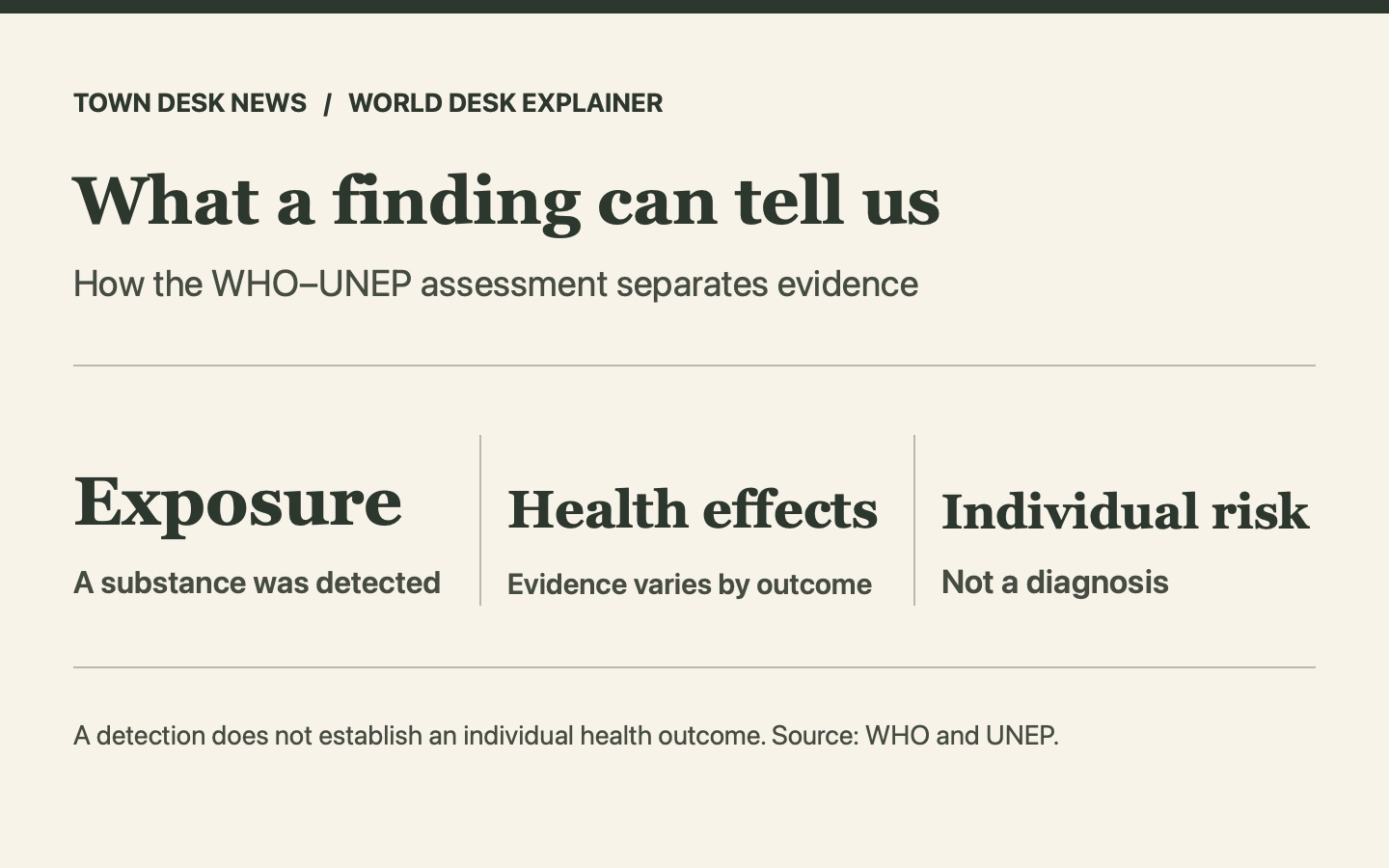
The assessment separates evidence of exposure, research on health effects, and what can be inferred for an individual. Town Desk News · Original Town Desk News graphic; based on reporting and linked source.
Why mixtures complicate the picture
One of the largest complications is that people do not necessarily encounter one chemical in isolation. The agencies say research increasingly recognizes exposure to mixtures, while regulatory systems often assess compounds one at a time. That mismatch makes it harder to use a finding about a single chemical to interpret every real-world exposure. The review puts those testing and identification questions alongside its discussion of health and wildlife, rather than offering a single number that sums up risk.
The review also flags a testing gap. WHO and UNEP say more than 350,000 chemicals and mixtures are registered globally for production and use, but only a small fraction have been evaluated for the properties discussed in the report. That figure describes the size of the testing challenge. It is not a count of chemicals known to disrupt hormones.
The authors discuss a wide range of uses, including some packaging, toys, pesticides and personal-care products. These are examples of where certain compounds may be used, not a finding that every product in those categories has the same ingredients or presents the same risk. The report also considers wildlife: it says researchers have connected exposure to changes involving reproduction, development and behavior across several animal groups.
What the agencies want to see change
The agencies published the assessment alongside a separate policy report. That companion looks at steps governments and companies could take in particular industries, including closer evaluation of chemicals and alternatives. The organizers announced both at a chemicals conference in Geneva, where governments, businesses and other participants met to discuss managing risks from chemicals and waste. The reports themselves do not enact a ban or require a change to a specific item on a shelf.
The headline about prenatal exposure answers one question, whether exposure can happen that early. The assessment tackles other questions with different evidence: which effects are better supported, who or what was studied, and where testing and policy have not caught up. Readers can use the full report for that distinction and the separate policy document to see what the agencies think should change next. Neither replaces individual medical advice about a specific exposure.
Sources & reporting notes
- Joint release
WHO and UNEP: joint announcement and findingsSummarizes the new findings, the supporting evidence and areas where uncertainties remain.
- Scientific assessment
UNEP and WHO: State of the Science of Endocrine-Disrupting Chemicals 2026Official repository for the full assessment and the evidence it reviewed.
- Policy synthesis
UNEP: From Evidence to ActionCompanion report on proposed changes across industries and sectors.
- Scientific background
U.S. National Institute of Environmental Health Sciences: Endocrine DisruptorsExplains how endocrine disruptors interact with hormones and gives examples of exposure research.
See something we should correct?
Some or all of the images may have been generated by AI for illustration purposes only.