NASA calculates Voyager 1 has reached one light-day from Earth
NASA’s trajectory calculation puts the milestone at 5:16 a.m. Eastern on Nov. 18. The agency said it was still awaiting a confirmation signal.
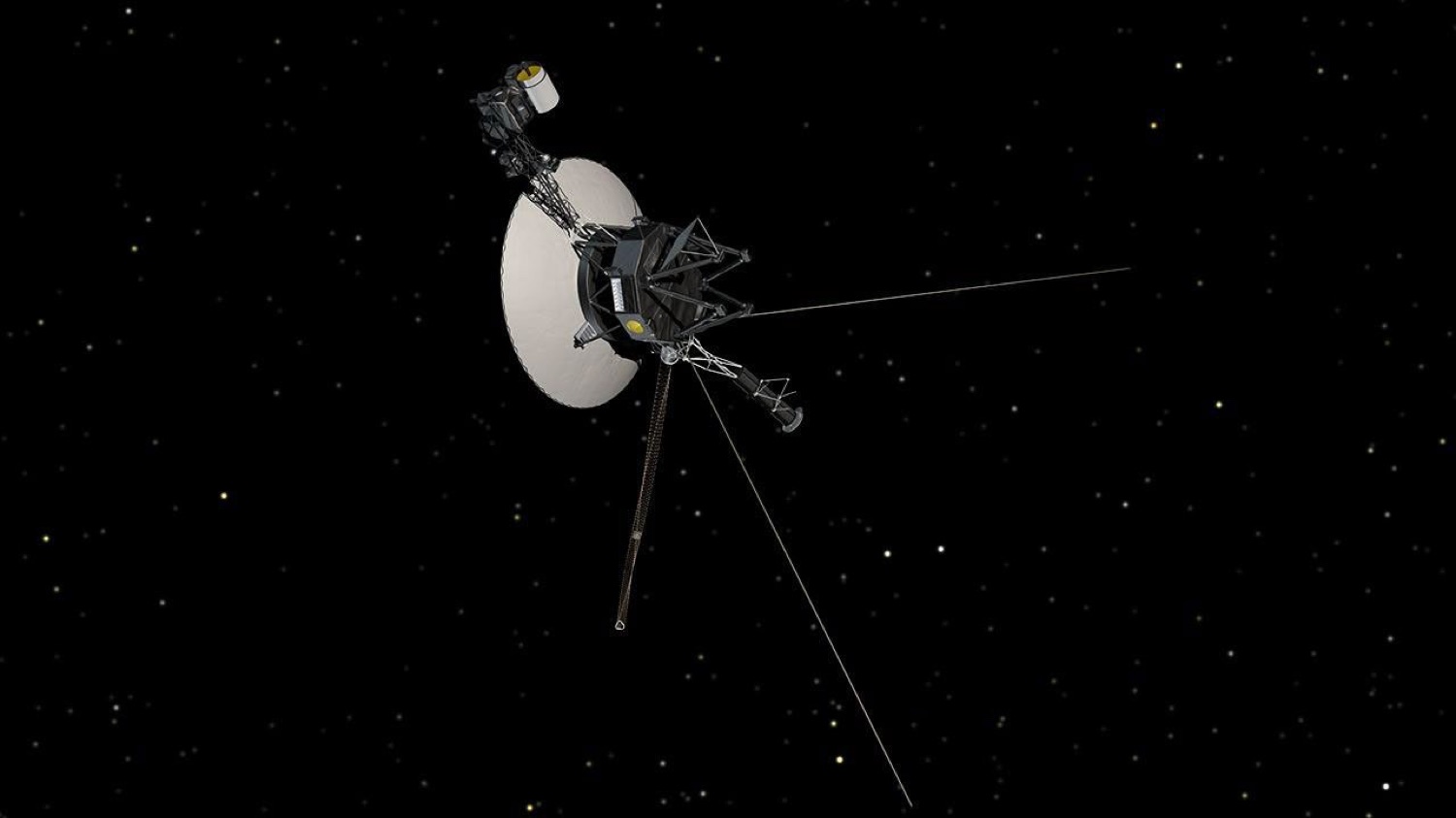
NASA/JPL-Caltech illustration released Sept. 12, 2013; not a photograph of Voyager at the milestone. NASA/JPL-Caltech · NASA editorial media guidance; credit NASA/JPL-Caltech. Official 2013 artist’s concept PIA17049, not an actual photograph or AI image; resized. · Edited
NASA calculates that Voyager 1 became the first human-made object to reach one light-day from Earth at 5:16:07 a.m. Eastern (10:16:07 UTC) on Nov. 18. That puts the spacecraft about 16.1 billion miles away. NASA said it was still waiting for a confirmation signal. The distance milestone and the time Earth can receive a radio signal from that distance are two different things.
One light-day is a measure of distance, not a new unit of calendar time. It is the distance light travels in a vacuum in twenty-four hours. Radio signals travel at that same speed in space. A radio command transmitted toward Voyager 1 around the milestone would therefore take about a day just to arrive. Any immediate response would need roughly another day to make the return trip. That is a minimum travel time, not an assurance that NASA can always get an answer on a particular schedule.
How NASA sees a spacecraft it cannot visit
The milestone was calculated from the spacecraft’s trajectory and its distance from Earth. That calculation is separate from a signal received on Earth; it is not itself a telemetry confirmation. The exact distance changes over time as the spacecraft travels and Earth moves around the Sun. The figure is measured from Earth for this milestone, rather than from the Sun or from the boundary of the solar wind.
NASA uses the Deep Space Network, a system of large antennas operated through its Jet Propulsion Laboratory, to receive the spacecraft’s very faint radio signals and send instructions. The light-day calculation makes the delay tangible, but the delay has been growing throughout the mission. It limits how quickly engineers can diagnose problems, see whether a command worked or correct an unexpected result. An update may need more than one exchange, and the network also has to communicate with other missions.
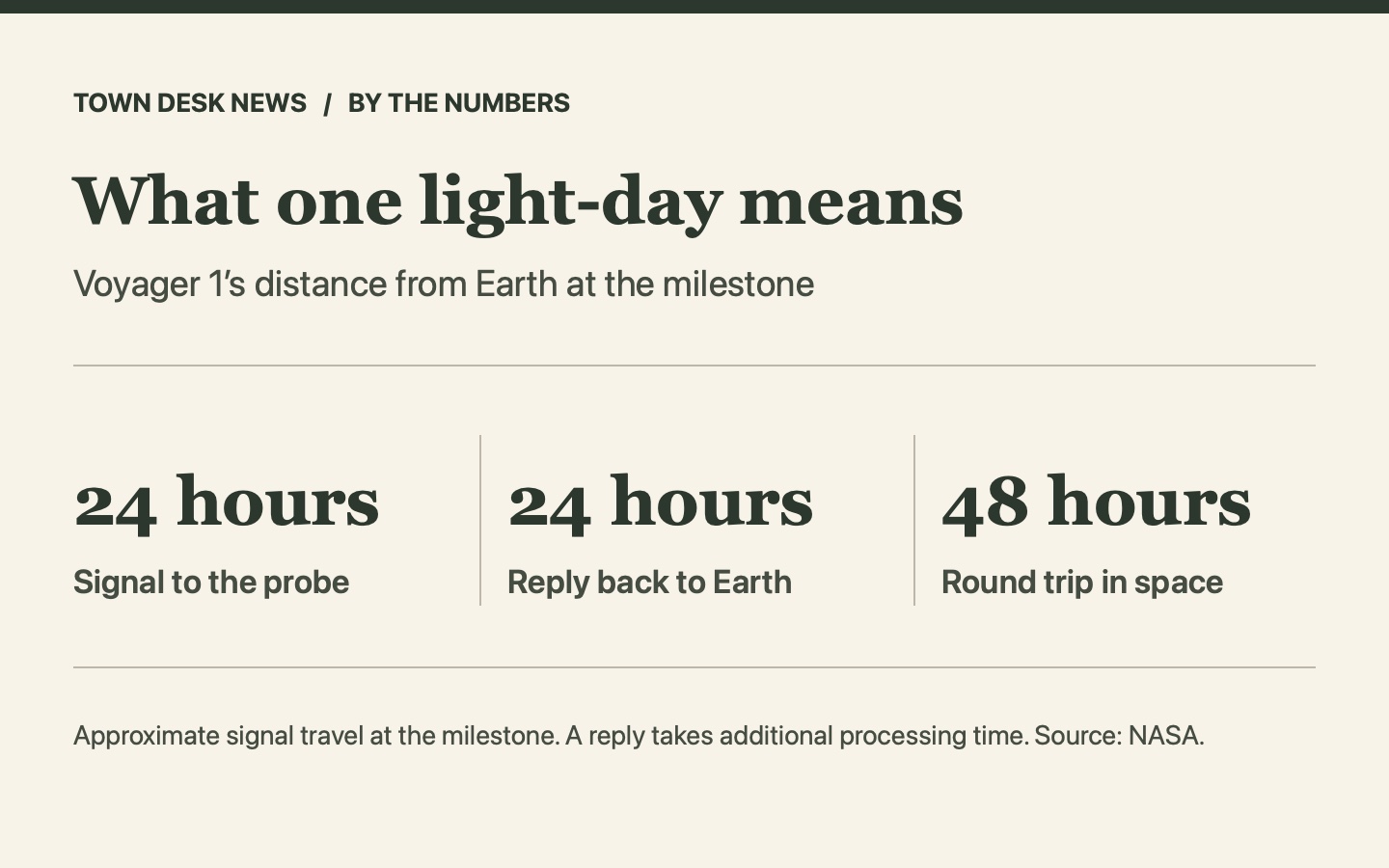
A signal travels for roughly two days round trip at the one-light-day milestone, not counting processing. Town Desk News · Original Town Desk News graphic; based on the linked source.
What the spacecraft still does
Voyager 1 launched in 1977. It flew past Jupiter and Saturn before heading outward. The route of its twin, Voyager 2, also took it past Uranus and Neptune. Both spacecraft went on to enter interstellar space, beyond the heliosphere, the region dominated by the solar wind and the Sun’s magnetic influence on surrounding space. That crossing was a different event from this distance record. Traveling another milestone farther from Earth does not mean either spacecraft just crossed a new physical boundary.
The instrument status on NASA’s tracker shows that Voyager 1’s magnetometer and plasma wave subsystem are still on. The former monitors magnetic fields, while the latter observes waves in the charged particles around the spacecraft. NASA has switched off other instruments, such as the cosmic-ray subsystem and the low-energy charged-particle instrument on Voyager 1, to conserve power. Voyager 2’s status is different; the mission pages provide separate lists for each spacecraft.
The spacecraft were built to operate far from the Sun, where solar panels would receive little energy. Radioisotope power sources supply electricity, but the available electrical output declines over time. The mission team can preserve some scientific instruments and basic spacecraft operations by deciding which loads to shut off. A distance record does not change the available power or guarantee how long the remaining equipment will operate.
What readers can see for themselves
NASA’s tracker compares the two spacecraft’s positions and links to a three-dimensional visualization with Jupiter, Saturn and other reference points. That is a better way to understand the mission than picturing Voyager traveling toward a nearby star at the speed of its own radio signal. Its radio moves at light speed; the spacecraft does not. What took Voyager 1 nearly half a century to cross can be traversed by a radio wave in one day.
NASA also published a set of downloadable mission graphics for the milestone. Some depict the spacecraft and its route rather than photographing the probe at its current location. The distinction is worth keeping: the instrument readings and radio signals are measurements from real hardware, while the images used to explain where the probe is now are visualizations.
Sources & reporting notes
- Agency mission data
NASA Voyager mission statusGives the modeled time and distance, routing diagrams and current instrument status.
- Agency resource
NASA light-day graphics and contextMarks the distance milestone and provides credited visual assets.
- Independent reporting
Reuters coverageConfirms the reported milestone is based on NASA calculations and explains the communications role of the Deep Space Network.
- Agency status
NASA Science milestone statusNASA Science said it was awaiting a confirmation signal after the calculated threshold.