Vietnam changed what has to happen before land can be taken
For some priority projects, authorities could decide to take land before compensation plans are approved. Vietnam’s revised land law also expands what compensation can look like.

Vietnam’s National Assembly building in Hanoi, photographed in December 2016. This archive image does not show the Nov. 21, 2026 vote. Xiquinho Silva / Wikimedia Commons · CC BY 2.0

Vietnam’s National Assembly voted on Saturday, Nov. 21, to change the order of two decisions that can shape a family’s future: whether the state will take its land and what the family will get in return. For certain projects, authorities could decide to acquire land before they give final approval to a compensation plan. The change is part of a revised land law that takes effect mainly on July 1, 2027.
Vietnam’s government news portal reported that 466 of the 479 deputies present backed the law. The dispute behind the procedural change is familiar in places where a public project is proposed on privately used land. Reuters reported that residents and farmers have objected when they believed government offers fell short of what the land was worth, and that those disputes have delayed infrastructure and industrial projects.
What officials can do earlier
Under the earlier process, Reuters reported, authorities generally had to approve compensation plans before they could decide to take the land. Under the revised rules, the decision to take land can come earlier in some cases. Two conditions are important: the compensation plan must already have been made public, and the acquisition must not require resettlement.
Publication and approval are separate steps. A plan that residents can read is not necessarily a plan that officials have approved. Nor does the new sequence mean that a public notice by itself is enough. Reuters reported that the provision can cover nationally important projects, urgent public investment and certain cases where more than three quarters of the affected land users agree. That is not a blanket threshold for every public project.
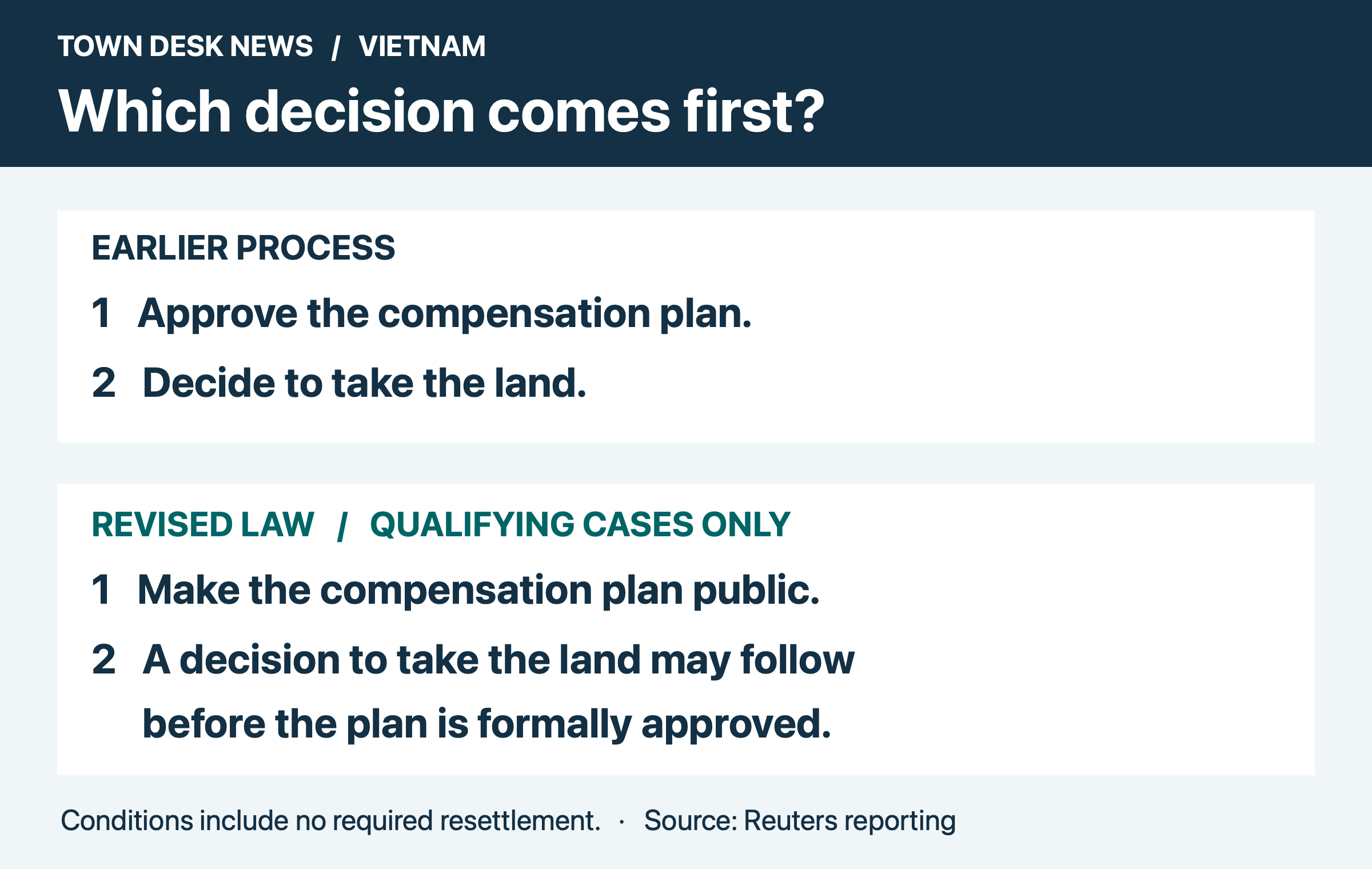
The revised sequence is limited to qualifying cases. It still requires prior public disclosure, and resettlement must not be necessary. Town Desk News · Original Town Desk News explanatory graphic
The distinction matters for a farm or business that could lose land without someone having to move out of a home. A construction and real estate lawyer told Reuters the change could be more relevant to farmland than to residential property for that reason. Whether it can be used for a particular project depends on the legal category and conditions, not just on how fast officials want work to start.
Compensation may mean land, not a check
The government’s account puts more emphasis on the choices a household may be offered. Generally, the first option is land for the same use as the parcel being taken, through an allocation or lease. If that kind of land is unavailable, a locality with the necessary land or housing may offer a different type of land or a home, if the person losing land wants it.
Money remains an option in certain circumstances. The government’s explainer describes exceptions for residential property, so it would be a mistake to read the new law as letting every household choose between cash, land and housing on the same terms. The options depend partly on what the locality actually has available, in addition to the legal rules and the person’s preference.
There is also a difference between the value of the land and what is on it. The government notes that damage to buildings, crops and livestock can be compensated under separate provisions. It says provincial authorities will set local rates for those kinds of losses. Two compensation plans could look different even if the general rule on land replacement is the same.
A different question: who can get a land certificate?
The overhaul also widens the circumstances in which some long-time land users may be considered for a land-use certificate, commonly called a red book. The government describes pathways for some people who used land before July 1, 2014, without the ordinary paperwork, and for some people who acquired usage rights before Aug. 1, 2024, without formally recording the transfer.
Those dates describe possible eligibility, not an automatic certificate. Someone must still meet the relevant legal conditions. The certificate provisions are also separate from the change to when an acquisition decision can be made. One is about recording rights to use land; the other is about when authorities can start the process of acquiring it.
The vote is not the start date
Most provisions are due to take effect July 1, 2027. Land price tables and adjustment factors under the revised rules are scheduled for Jan. 1, 2028, the government said. In the meantime, the vote is not evidence that a particular project qualifies, that compensation has been approved or that anyone must move.
For an affected household, the key documents will be the project decision and the local compensation plan. They can show which route authorities say the project qualifies for, what is being offered and whether the plan is still awaiting approval. The parliamentary vote changes the framework. The answer for any one household will still depend on what the local documents say.
Sources & reporting notes
- Government record
Vietnam government policy portal: National Assembly vote on the amended lawConfirms the vote, main effective date and timetable for new land pricing.
- Government explanation
Vietnam Government News: land-use certificates and compensation optionsExplains the documentary cutoffs, compensation hierarchy and local role in setting asset compensation.
- Independent reporting
Reuters: what changes for priority projectsDescribes the conditions for making acquisition decisions before final plan approval and the debate over project delays.