The UK and EU agreed on a youth visa. Why can’t anyone apply yet?
The Brussels deal outlines up to three years abroad. It ends negotiations, not the wait for applications.

The Europa building in Brussels, photographed in September 2026. The archive image does not depict the November summit. FrDr / Wikimedia Commons · CC BY-SA 4.0

A young British citizen who wants to spend a year working in one European country before moving to another generally needs to navigate separate national rules. A plan agreed in Brussels on Friday, Nov. 20, lays out a future route that could make that easier for some people. But it is not a visa application that anyone can fill out now.
In their joint statement, European Union and UK leaders said negotiations on the Youth Experience Scheme were complete. They set two different goals: for the agreement to apply by 2028, and for people to have opportunities under the scheme by January 2030. Neither date is a confirmed application opening. The UK government separately says it expects the first participants to travel no later than January 2030.
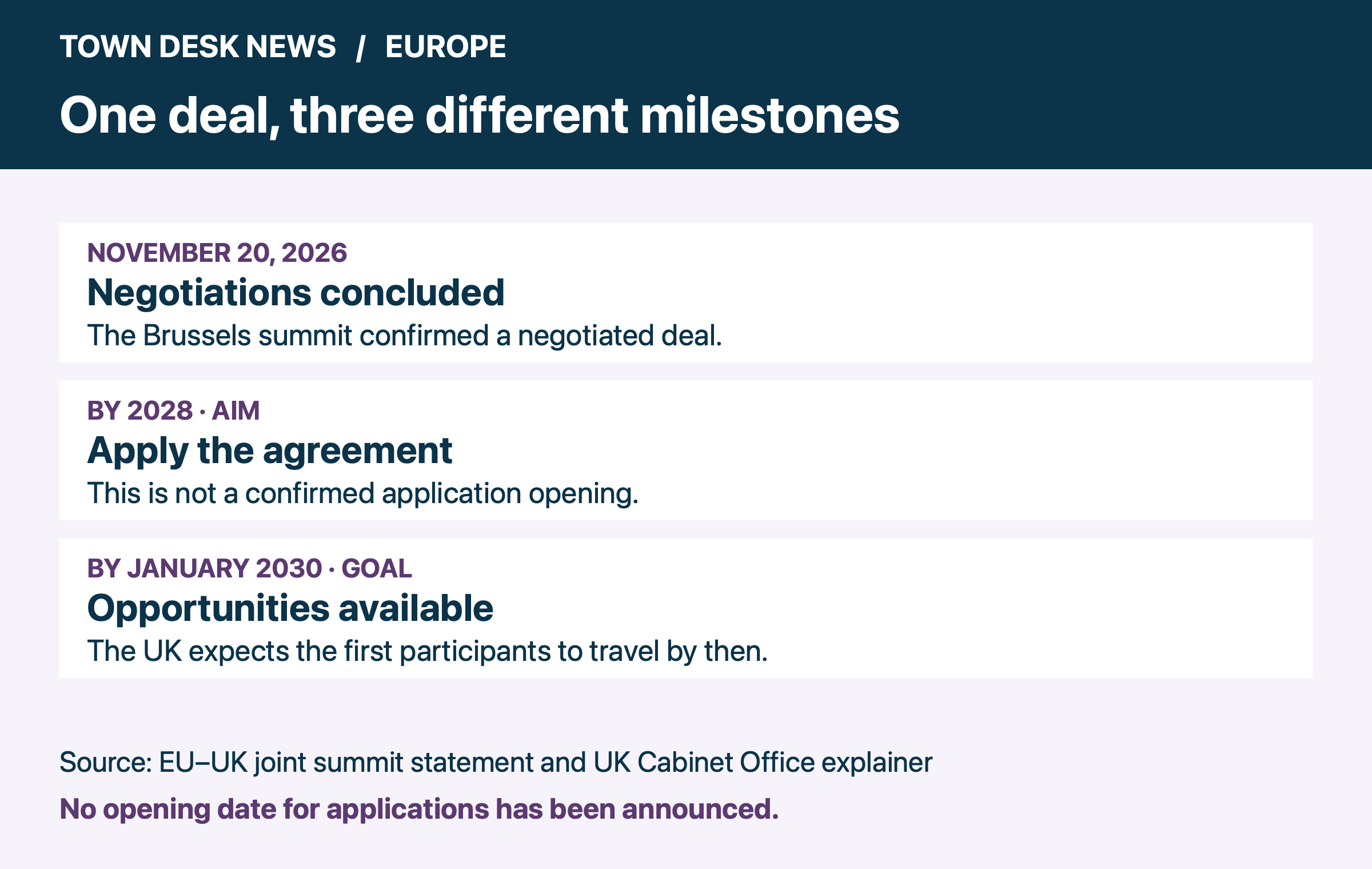
The joint statement lists goals for the agreement and the first opportunities. It does not set the date the application form goes live. Town Desk News · Original Town Desk News explanatory graphic
The flexibility is the consequential change. Someone who went abroad to study would not necessarily be locked into studying for the life of the permit. Work, travel, volunteering and au pair placements are among the activities contemplated. Participating countries can still set limits on access to their labor markets. The UK says the detailed terms and restrictions will be published before the agreement is signed.
Three years is the ceiling, not the first permit
The negotiated design is for a two-year initial visa or residence permit, with a possible third year. Eligibility is for British citizens and citizens of participating EU member states who are 18 through 31 on the day the permit begins, according to the UK Cabinet Office’s explainer. A 31-year-old looking at the announcement today should not assume they will still qualify when the route opens.
Up to 100,000 people from each side could participate annually. For British applicants, that does not translate into 100,000 places in each country. The UK says the places will be divided among participating member states using relative population size. The agreement sets the overall cap, not the odds of a specific applicant getting a place in their first-choice country.
A British participant would apply to a participating country, not receive an unrestricted permit for all of Europe. The proposed rules allow a participant to move between participating states at most twice. The Cabinet Office says a participant would have to live in one member state for a year before switching. That could suit someone planning in year-long stretches; it is not the same as choosing a new home country every season.
The cost and the limits matter
The proposed route does not include public benefits or the ability to bring dependants. Applicants would need to show they can support themselves and pay an application fee. The UK’s explainer says people coming from the EU to Britain would pay an immigration health surcharge at three-quarters of the regular rate. British citizens applying to live in participating EU countries would need comprehensive health coverage.
The Cabinet Office also says applicants will need to indicate a main planned activity and confirm they have not used the scheme before. Stating an intended activity is not, by itself, a commitment to do only that activity. What a participant can actually do will depend on the final rules in the country that issues the permit. The published explainer does not set a specific application fee.
The plan does not restore the wider freedom of movement that applied before the UK left the EU. It is capped, age-limited and requires a permit. Someone planning a move in the meantime still needs to follow the immigration and travel rules that apply now, rather than rely on a proposed scheme with no confirmed application date.
A separate education deal
The summit also moved forward Britain’s participation in Erasmus+ in 2027. The joint statement says a funding call already opened on Nov. 18 for eligible institutions. That opening is for the education program, not applications for the new youth visa. A student considering an exchange and a person hoping to combine work and travel should not assume they have the same application, timetable or eligibility rules.
For prospective participants, the first useful milestones are the finalized terms, the rules in the country where they would like to live, and an official opening date. The summit provides a clearer framework for what a future stay could look like. It is not a reason to book transport, pay a visa agent or make other commitments now.
Sources & reporting notes
- Joint government statement
UK–EU joint summit statement: Youth Experience Scheme and Erasmus+Separates the target for applying the agreement by 2028 from the January 2030 target for opportunities.
- UK government explainer
UK Cabinet Office: Youth Experience Scheme explainerDetails the proposed age cutoff, six main eligibility and application conditions, permit length, switching rules and costs.
- EU summit readout
European Council: summary of the Brussels summitConfirms the Nov. 20 summit, the conclusion of youth scheme negotiations and the separate Erasmus+ agreement.
- Independent reporting
Reuters: what the UK and EU agreed at the summitProvides independent reporting on the overall summit package and the mobility cap.