The Senate passed a permitting overhaul. It still needs House agreement.
The 62–33 vote advances the Bipartisan American Affordability and Jobs Act. Senate passage does not make it law or change a household’s electricity bill.
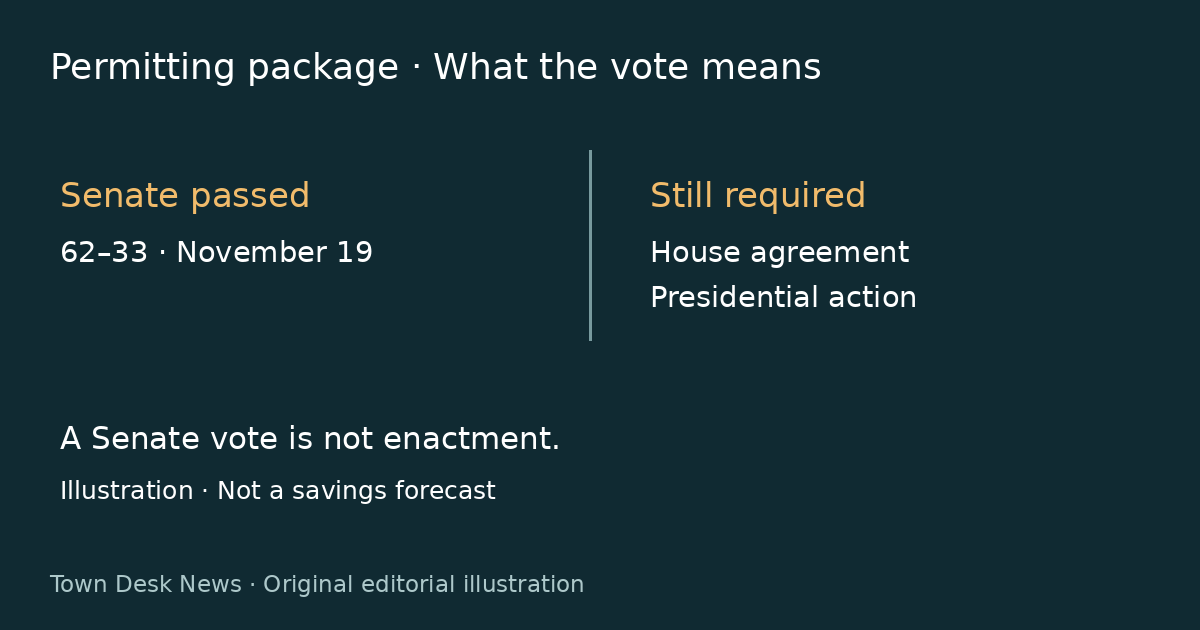
The Senate voted 62–33 Thursday, Nov. 19, to pass a broad permitting package using an amended version of H.R. 2347. The official roll call records passage, and the bill’s Senate sponsors identify the package as the Bipartisan American Affordability and Jobs Act of 2026, or BAAJA. It still needs House agreement and presidential action before becoming law.
A vote is not a change to a power bill
Sponsors say the package is intended to speed energy and infrastructure development and make data centers bear more of the electricity and grid costs associated with their demand. Those are the sponsors’ stated aims. Senate passage alone does not lower a customer’s bill, award a project permit or put a new cost-sharing rule into effect.
The Senate adopted a substitute amendment, No. 6883, on Nov. 18 before passing the amended bill the next evening. If enacted, Section 2107 of that substitute would direct the Federal Energy Regulatory Commission to revise its transmission-pricing policy. Utilities would charge eligible large computing customers the existing cost of transmission service plus a reasonable estimate of added transmission costs determined by the regulator. The provision concerns eligible customers; it is not a claim that every data center faces the same charge or that household savings are guaranteed.
The next decision belongs to the House
The Senate Energy and Natural Resources Committee’s Nov. 19 passage statements say the bill now goes to the House. The House must agree to the same text before it can be sent for presidential action. No confirmed House vote date was established in the official schedule reviewed for this brief.
For readers following the proposal, the next useful records are the House’s floor notice, any text it takes up and a recorded decision. A sponsor’s prediction of lower costs is different from a guaranteed saving, and a forecast of action after Thanksgiving is different from a scheduled vote.
Sources & reporting notes
- Senate: final Nov. 19 roll call, H.R. 2347 as amended
Official passage 62–33. The vehicle’s older tax title is not used to infer the substitute’s detailed provisions.
- Senate: adopted substitute No. 6883, Nov. 18
Official adoption of substitute No. 6883; read with its verbatim Congressional Record text. Later managers’ proposals were not adopted.
- Congressional Record: adopted substitute No. 6883, Section 2107
Amendment number and title bind the text; Section 2107 directs FERC transmission-pricing revisions for eligible computational-load customers. Detailed exclusions and modeled savings are not asserted.
- Senate Energy Committee: Lee passage statement
Sponsor identification and next chamber, not an independent guarantee of savings.
- Senate Energy Committee: Heinrich passage statement
Sponsor-attributed data-center/grid purpose and House/presidential steps. No modeled savings or employment figure adopted.
- House Majority Leader: weekly schedule
Schedule reviewed did not establish a vote date for the Senate package; not an exhaustive claim about every House action.
- Roll Call: Nov. 19 original reporting
Independent account distinguishes the adopted substitute from late managers’ changes that did not advance.