PPL, Duquesne and PECO default supply rates rise Dec. 1. Check which rate applies.
The PUC’s PECO table joins the PPL and Duquesne comparison. Supply-only examples use fixed consumption and are not household total-bill forecasts.
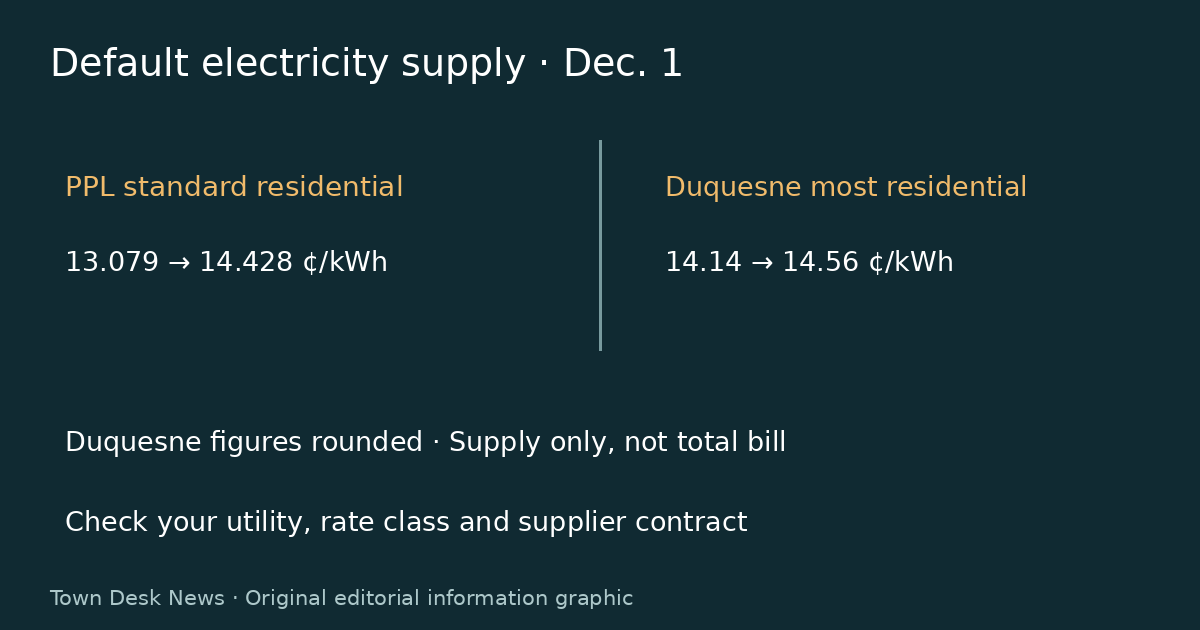
PPL Electric Utilities, Duquesne Light and PECO have published higher residential default-service supply rates for Dec. 1. The changes apply to customers who buy electricity supply through the utility’s default service; a separate supplier contract can have different prices and dates.
PECO’s December default supply price
The Pennsylvania Public Utility Commission’s Nov. 23 table lists PECO’s standard residential Price to Compare rising from 11.759 to 12.965 cents per kilowatt-hour on Dec. 1. At unchanged usage of 700 kWh, that difference adds $8.44 to the supply charge after rounding. This calculation excludes other bill items and changes in electricity use; it is not a forecast of the total monthly bill.
PPL’s standard residential Price to Compare rises from 13.079 cents per kilowatt-hour through Nov. 30 to 14.428 cents from Dec. 1 through May 31, 2027. At a fixed 700 kWh, that difference adds $9.44 to the supply charge after rounding. It is an illustration using the published rates, not a prediction of a customer’s total bill.
Duquesne publishes rounded rates of 14.14 cents rising to 14.56 cents for most residential default-service customers. Its example is about $2.49 more at 600 kWh. The tariff’s underlying residential supply increase is 0.4150 cents per kWh, which explains why subtracting only the rounded headline rates gives a slightly different result.
Supply and delivery are separate parts of a bill. PPL’s territory includes parts of the Lehigh Valley and Lancaster area; Duquesne serves communities in Allegheny and Beaver counties, including Pittsburgh. Service boundaries vary, so check the utility and rate class printed on your bill rather than assuming these figures apply across the state.
The Pennsylvania Public Utility Commission’s PA Power Switch site explains supplier rates and contract terms. For eligible households needing heating assistance, the state lists the 2026–27 LIHEAP season as open through April 23, 2027. Checking eligibility does not guarantee a grant. A rate published for one utility does not establish another utility’s rate.
Sources & reporting notes
- PPL: current residential rate history
Current July–November residential rate: 13.079 cents/kWh.
- PPL: Dec. 1 revised Price to Compare
Standard residential 14.428 cents/kWh, Dec. 1–May 31. Usage illustration is supply only.
- PPL: service territory
Municipality-level boundaries vary.
- Duquesne: Dec. 1 customer explanation
Nov. 20: rounded most-residential rates and utility’s own 600-kWh illustration.
- Duquesne: tariff supplement 111
Residential supply rows change by 0.4150 cents/kWh; title lists Allegheny and Beaver counties.
- PA Power Switch: official PUC resource
Check rate class and supplier contract terms.
- Pennsylvania DHS: LIHEAP season
Nov. 2, 2026–April 23, 2027 season; eligibility applies.
- PUC: residential December price table
Published Nov. 23, 2026: PECO 11.759 to 12.965 cents/kWh. The 700-kWh supply-only difference is $8.44 after rounding.
- Energy Choice Matters: final PECO tariff coverage
Nov. 13 reporting distinguishes the final residential Price to Compare from the earlier indicative figure.