Libya says oil is moving again from one of its biggest fields. What’s still unknown?
The state oil company says crude transport resumed from Sharara on Monday. An earlier warning of a 350,000-barrel daily loss was a projection, and a separate disruption remained unresolved.
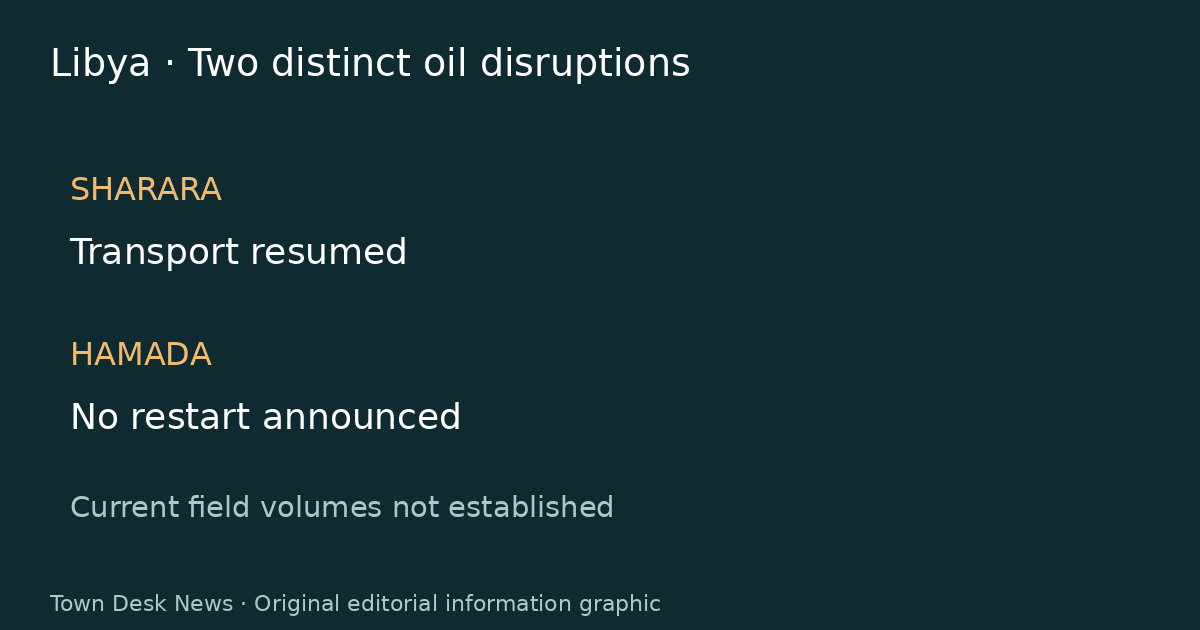
Libya’s state oil company says crude from its Sharara oil field started moving again Monday, Nov. 23, after an interruption that prompted a warning about a potentially large production loss. The restart establishes that crude transport resumed. It does not establish how much oil was moving or whether the field had returned to its earlier production level.
The chairman of Libya’s National Oil Corporation told Reuters on Monday that Sharara had reopened and crude was beginning to flow into storage. The report did not give an updated measured volume for the field.
What the daily estimate actually meant
Earlier, the Libyan News Agency carried the corporation’s warning that the Sharara interruption could cost about 350,000 barrels of production per day. The Arabic notice put the expected loss in future terms. It did not say that 350,000 barrels had already been lost, and the later restart statement did not say that 350,000 barrels a day had been restored.
A daily rate does not establish the total loss from a temporary interruption. That would require knowing how long output was affected and how much production was curtailed during that period. Nor does the arrival of crude in storage by itself show how much was produced Monday or shipped to customers. The sources checked did not give those measurements.
A separate interruption remains
The earlier corporation statement, carried Monday by the Libyan News Agency, said the separate Hamada interruption had lasted more than two weeks and accounted for a loss of roughly 15,000 barrels a day. It put the combined daily impact at around 365,000 barrels, pairing the expected Sharara loss with the already ongoing Hamada loss. That combined figure preceded the Sharara restart and is not a new estimate of losses after it.
The company had reported the Hamada disruption separately on Nov. 21. The account of the Sharara restart did not announce any resumption at Hamada. A return of flows at one field is not an all-clear for the country’s oil output.
Why it matters to Libya
Oil and gas are central to the country’s public finances. The U.S. Energy Information Administration estimated that crude oil and natural gas export revenues accounted for 97% of Libya’s government revenues and 93% of its export value in 2023. Those are historical estimates, not a measure of the revenue Libya lost this week. They help explain why the state oil company treated the interruption as an economic concern.
The next useful update would be a measured Sharara production figure or confirmation that Hamada has resumed. Monday’s announcement supplied neither. What it did supply was narrower: oil had started moving again from Sharara.
Sources & reporting notes
- Reuters: chairman’s Monday restart account
The NOC chairman said crude transport had resumed; no measured current field volume was given. Checked 2026-11-23T15:11:40Z.
- Libyan News Agency: earlier NOC warning in Arabic
Published Monday Nov. 23, the report describes the NOC statement as issued Sunday. Its 350,000-barrel daily Sharara loss is projected; the roughly 15,000 Hamada loss was ongoing.
- Libyan News Agency: separate Nov. 21 Hamada account
Earlier reporting of the separate interruption, not confirmation of any restart.
- EIA: Libya’s historical economic context
December 2024 analysis estimates 2023 revenue and export shares. These are historical measures, not this week’s losses.