The court faulted a $1.7 trillion vote. Its order was much narrower.
The Fifth Circuit ruled 9–8 that pandemic-era proxy votes did not count toward a House quorum. The order it affirmed bars enforcement of a pregnancy accommodation law against the State of Texas.
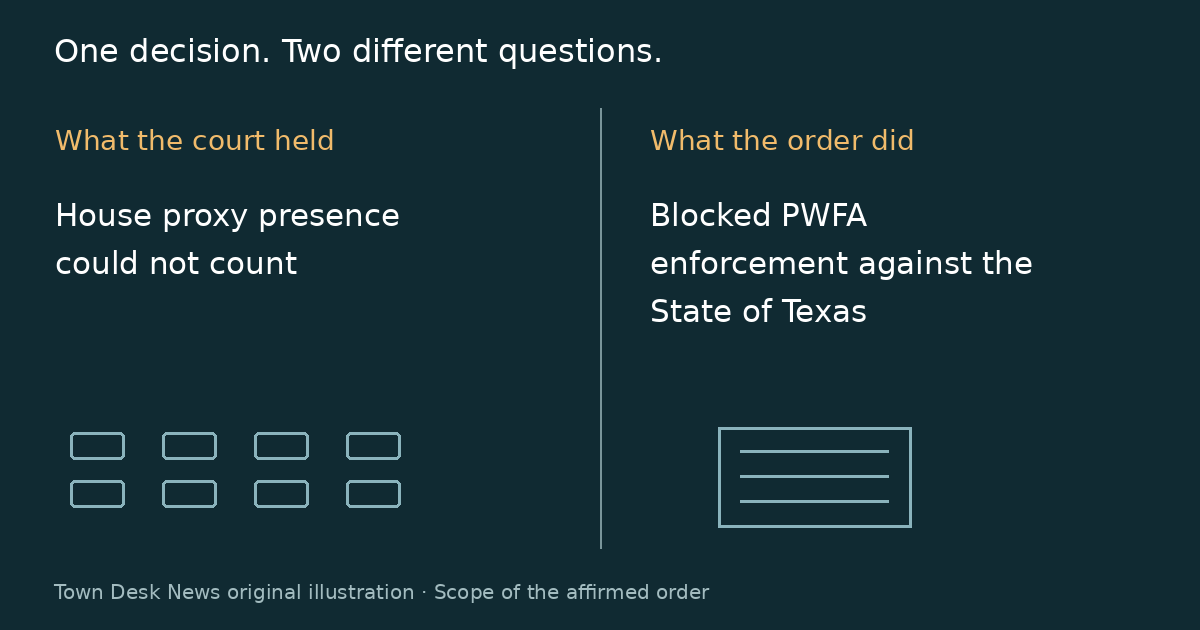
A federal appeals court held Friday that the House could not count members voting by proxy toward a constitutional quorum when it passed a $1.7 trillion spending package in December 2022. But the order the court upheld was much narrower: it bars federal officials from enforcing one part of that package, the Pregnant Workers Fairness Act, against the State of Texas and its agencies.
The full U.S. Court of Appeals for the Fifth Circuit divided 9–8 in State of Texas v. Blanche. The majority expressly limited its judgment to the relief that Texas won in the trial court. It did not issue an order voiding the rest of the spending law or blocking the pregnancy accommodation law against all employers nationwide.
Why a vote in 2022 still matters
The Constitution generally requires a majority of each chamber to be present for it to conduct business. During the pandemic, the House let lawmakers designate colleagues to vote for them and count their presence for quorum purposes. The House clerk recorded the December 23, 2022, vote as 225 in favor and 201 opposed, with one member recorded as present and four not voting.
The size of that voting tally was not the issue. The court’s opinion says 205 lawmakers voted in person; the others whose participation was recorded were represented by proxy. The majority said assigning a proxy could not make an absent member present for purposes of a quorum. President Joe Biden signed the measure into law. The majority held that the House vote did not meet the Quorum Clause.
An earlier three-judge panel on the same court had rejected a physical-presence requirement and vacated the injunction. The full court set that panel decision aside when it agreed to rehear the case. In Friday’s dissent, Judge James Graves Jr. and six colleagues argued, among other things, that courts should not look behind the formally authenticated law to revisit the House’s determination that it had a quorum.
What the ruling does and does not change
The Pregnant Workers Fairness Act generally requires covered employers to make reasonable changes at work for known limitations tied to pregnancy, childbirth or related medical conditions unless those changes would impose an undue hardship. The Equal Employment Opportunity Commission says it is an accommodations law. Separate federal laws address employment discrimination, and state and local safeguards can be more protective.
Friday’s judgment concerned enforcement of that one law against Texas as a state employer. It does not by its own terms block enforcement against a private business in Texas or against employers in Louisiana and Mississippi. Because the Fifth Circuit’s legal reasoning could matter in later disputes, the judgment’s narrow wording does not answer every question other employers or workers may face.
The broader constitutional question is whether other laws passed using the same House procedure could face separate challenges. This court did not decide relief for any such challenge here. For the ruling’s immediate effect, the most important distinction is between what the judges said about the House vote and who is covered by the order they affirmed.
Sources & reporting notes
- Fifth Circuit: State of Texas v. Blanche, No. 24-10386, Nov. 20, 2026
Majority opening and pp. 40–41 explain relief; dissent pp. 42–44 discusses the vote record. The opinion controls over secondary claims about geographic scope.
- House Clerk: Roll Call 549
Dec. 23, 2022 tally and proxy voting designation.
- Congressional Research Service: enactment of appropriations measures
The Senate passed the final package December 22, followed by the House vote December 23 and the president’s signature.
- EEOC: Pregnant Workers Fairness Act overview
Federal baseline, other laws and accommodations. This reporting does not determine individual eligibility.
- Reuters: national reporting on the decision
Independent reporting corroborates 9–8, the spending package and the Texas injunction.
- Washington Post: report on the decision and pregnancy protections
Supporting independent reporting; predictions about later disputes are not the legal effect of this judgment.