European hospital samples show widespread resistance to key antibiotics
WHO and ECDC found high resistance in samples from serious infections. The figures describe tested bacteria, not every patient or hospital in Europe.

File photo: CDC microbiologist Kitty Anderson holds two plates used for antibiotic susceptibility testing in 2014. These are not specimens from the European surveillance study. James Gathany / CDC Public Health Image Library · U.S. public domain; CDC and photographer credited as requested · Unmodified 700-pixel source JPEG; no crop.
In 21 of 43 reporting countries, at least half of the tested samples of Klebsiella pneumoniae from serious infections resisted an important group of antibiotics, according to a regional analysis released Nov. 18 by the World Health Organization’s European office and the European Centre for Disease Prevention and Control. The finding describes results among samples tested in each of those countries. It does not mean half of all infections or half of all hospital patients were affected.
The agencies combined 2025 data from two surveillance networks, one coordinated by ECDC for European Union and European Economic Area countries and one coordinated by WHO/Europe. The report concerns bacteria detected in blood or cerebrospinal fluid. Those records can reveal a severe problem in a subset of cases even if the national testing system does not capture all infections. Counts are therefore given for the countries reporting the specific bacterium and drug combination.
Three figures that answer different questions
The 21-of-43 figure refers to resistance in Klebsiella pneumoniae to third-generation cephalosporins. The same bacterium showed resistance to a different group of antibiotics, carbapenems, in at least half of tested samples in 10 of the 43 countries. In a separate measure, 21 of 38 reporting countries found carbapenem resistance in at least half of the tested Acinetobacter samples. Those denominators should not be combined or read as a single rate for the entire region.
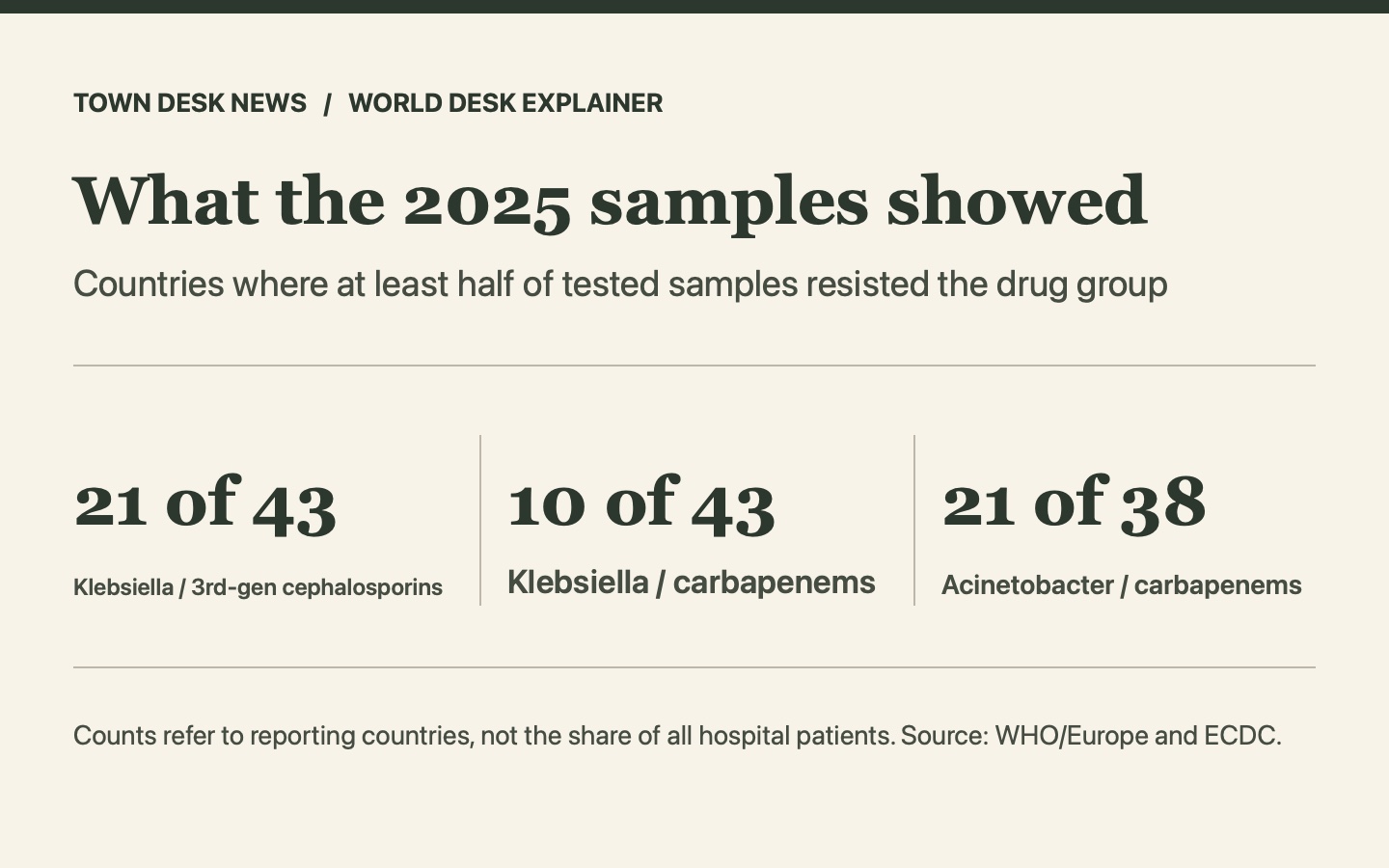
The figures describe tested samples in reporting countries, not all hospital patients. Town Desk News · Original Town Desk News graphic; based on reporting and linked source.
A resistance finding means a particular drug is less reliable against the bacterium that was tested. The agencies warned that losing reliable options against serious infections narrows what hospitals can use. They also stressed infection prevention, better reporting and efforts to preserve the effectiveness of existing antibiotics. The report is about public-health surveillance; the figures cannot tell a reader what care an individual patient needs.
Progress against EU targets is mixed
The European Union uses 2019 as the baseline for several 2030 targets. The estimated EU incidence of bloodstream infections caused by carbapenem-resistant Klebsiella pneumoniae rose 72 percent by 2025. The target calls for a five percent fall instead. Bloodstream infections caused by E. coli resistant to third-generation cephalosporins rose an estimated 16.4 percent; the target is a 10 percent reduction.
ECDC’s separate consumption figures present a related but distinct measure. Human antibiotic consumption was five percent lower in 2025 than in 2019, compared with a 20 percent reduction target for 2030. A consumption measure counts use; a bloodstream-infection measure counts disease. Improvements in prescribing and a rise in some types of resistant infection can therefore appear in the same year’s results.
The estimated incidence of bloodstream infections caused by methicillin-resistant Staphylococcus aureus, known as MRSA, fell 19 percent against a target decline of 15 percent. That puts the latest estimate beyond the target, but both agencies warned of increases in the past two years. A result can be better than 2019 and still be worsening relative to a more recent low. The date used for comparison changes the answer.
Why the agencies want better reporting
WHO/Europe said 16 of 51 countries with data still collect it without a standardized, nationally coordinated approach. Hospitals may test some patients more often than others, and severely ill patients are more likely to be represented where fewer samples are taken. The agencies caution that the surveillance networks use compatible methods but national practices differ. A higher reported share should not automatically be treated as proof that one entire health system has a worse burden than another.
There is also a funding gap between plans and implementation. WHO/Europe says 94 percent of countries in the region report either having a national action plan on antimicrobial resistance or revising one. Just 40 percent say they are carrying it out with both funding and ongoing monitoring. Work announced in six countries includes review of hospital prevention practices and antibiotic oversight, with coaching to follow in 2027.
The figures point to two separate tasks for governments. Better surveillance can show which infections are spreading and where. Implementing funded prevention and oversight programs can change the conditions that allow those infections to spread. Publishing the data accomplishes the first task in part; it cannot substitute for the second.
Sources & reporting notes
- Agency analysis
WHO/Europe joint-analysis releaseLists country denominators, European targets and surveillance limitations.
- Agency analysis
ECDC surveillance releaseReports EU trends and action priorities for public health authorities.
- Primary surveillance report
ECDC annual surveillance report for 2025Documents estimated incidence trends and baseline comparisons.