NASA moved an asteroid. A European spacecraft is trying to find out what changed
Hera’s cameras see the same asteroid in different ways. The next images could help researchers tell what NASA’s 2022 test did to the moonlet itself.
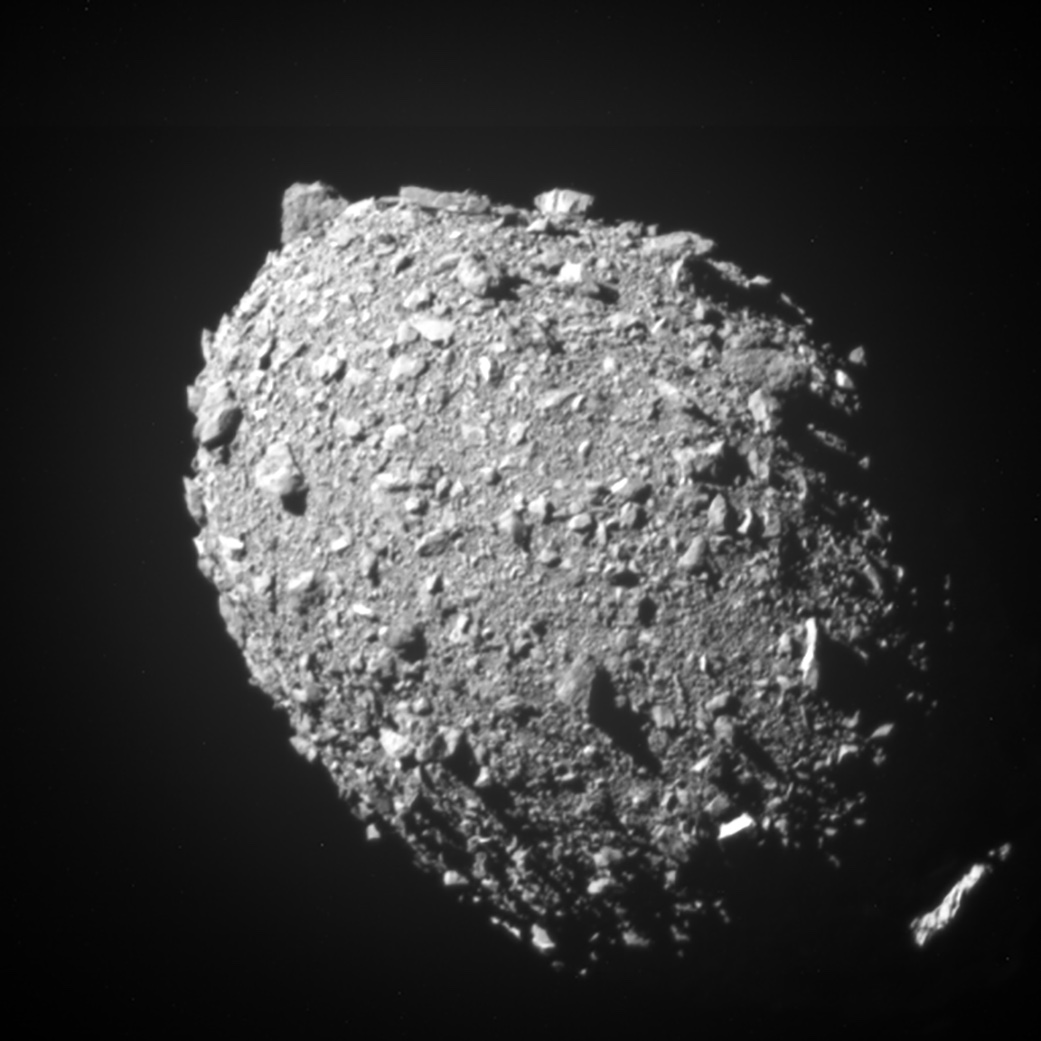
File image: NASA’s DART photographed the full moonlet Dimorphos 11 seconds before impact on Sept. 26, 2022. This is not a Hera image. NASA / Johns Hopkins APL · U.S. public domain, as identified in the linked NASA attribution and source record · Converted to JPEG; no deliberate crop or change to image content.

In one picture from the European Space Agency’s Hera spacecraft, the small asteroid NASA struck four years ago is mostly lost in shadow. In another, which records heat rather than visible light, its outline is there. ESA explained the difference Nov. 17 as Hera began studying the two asteroids up close. The mission is trying to learn what a collision designed to change an orbit did to the object itself. More detailed images of both asteroids are scheduled for release Nov. 25.
What NASA established in 2022
The smaller object is Dimorphos. It orbits Didymos, a much larger asteroid. NASA’s DART spacecraft deliberately collided with Dimorphos in September 2022. The pair posed no threat to Earth; researchers chose it so they could test whether a collision could measurably change an asteroid’s motion. Observations afterward showed that it could. Dimorphos began circling Didymos roughly 33 minutes faster than it had before, according to the agencies.
That measurement was possible without waiting for another spacecraft. Researchers could track when the two bodies passed in front of, or cast shadows on, one another and determine how often those events repeated. But knowing that an orbit changed does not reveal whether the collision dug a distinct crater or changed the body more broadly. Those outcomes would tell scientists different things about how a small asteroid absorbs an impact and sends material back into space.
Three ways to see the same asteroid
That is why ESA has sent a spacecraft with several ways to see the same surface. Its framing camera makes sharp black-and-white images that show the outline, shadows and boulders. The HyperScout H instrument measures reflected light in 25 bands, extending beyond red into the near infrared. Those measurements can be compared with laboratory observations of minerals and meteorites. The result can narrow down what the surface is made of, even where a normal photograph cannot distinguish one dark patch from another.
A thermal camera supplied by Japan’s space agency, JAXA, measures how warm and cool different parts of the surface are. Solid rock and loose material do not necessarily heat and cool the same way. Observing how temperatures change can therefore help researchers interpret the terrain. A feature noticed by one instrument is more useful when measurements from another give scientists a way to test what it might be.
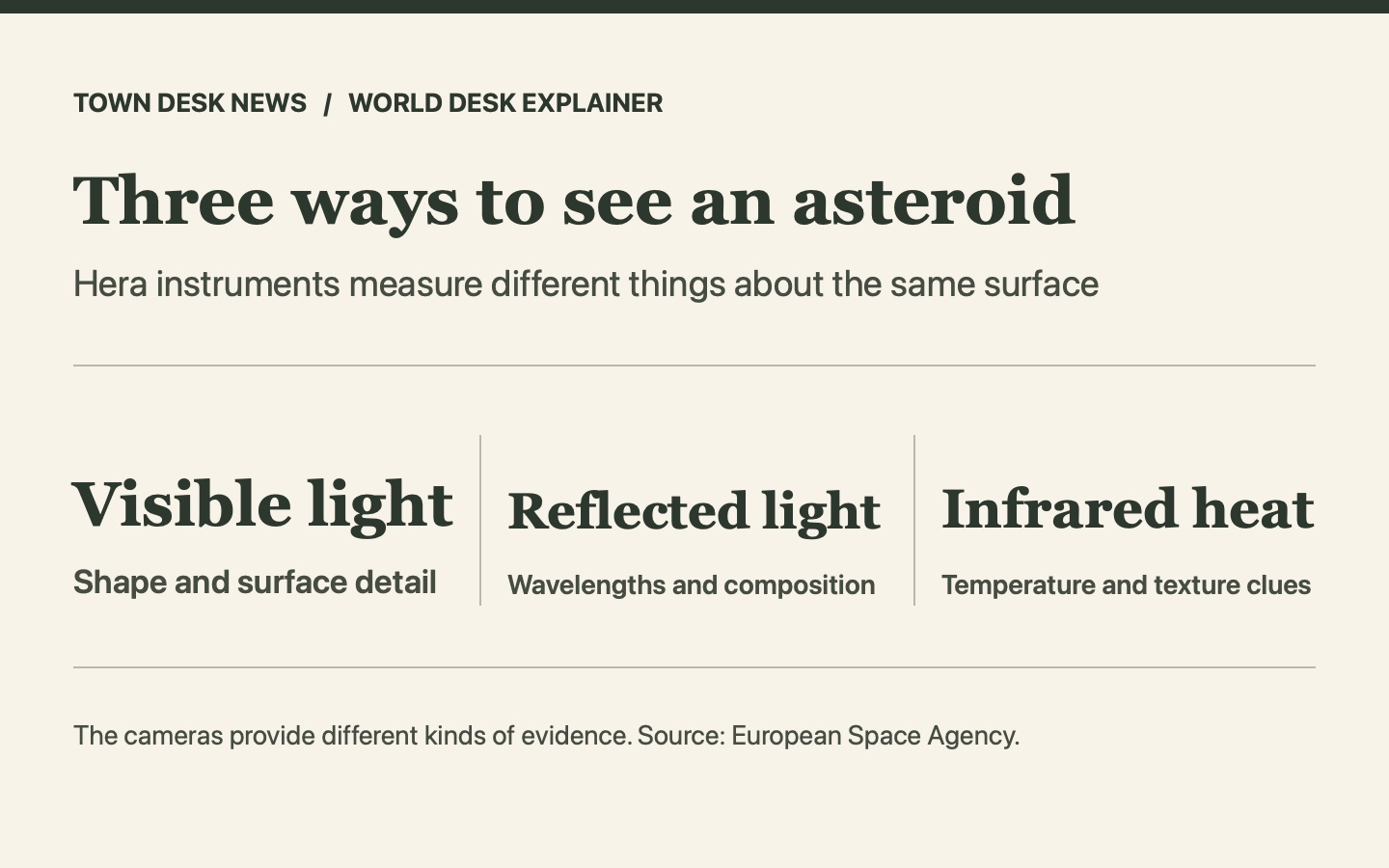
The three Hera instruments measure different properties; their data give researchers separate ways to test what they see. Town Desk News · Original Town Desk News graphic based on linked primary reporting; no third-party imagery.
Why one picture cannot settle it
There is a limit to what the pictures released so far can establish. ESA described Dimorphos as largely in shadow in the visible-light views, with only a small part lit. The thermal view sees the body without relying on reflected sunlight. That makes it useful for spotting the moonlet in the first place. It is not, by itself, a definitive map of the crater or proof the collision reshaped the entire object.
Hera launched in October 2024, two years after DART’s collision. The time between the two missions is part of what makes their evidence different. DART’s approach camera recorded Dimorphos before contact, while Earth-based observers watched for immediate changes. Hera’s measurements come after the debris cloud that made the impact easy to see has dispersed. It is looking for changes that remained.
The mission also carries two small companion spacecraft that ESA plans to deploy for a closer survey. Their observations will complement Hera’s rather than make a single close-up the final answer. By comparing the shape, surface and mass of Dimorphos with the measured orbit change, researchers can ask how much of the shift came from the spacecraft’s impact and how much came from material thrown away from the asteroid. That matters if a future mission ever has to predict the effect before it acts.
When the next images appear, look first at what each picture measures and how much of the surface it shows. A sharp outline is one piece of evidence. A map of temperatures or a set of measurements of reflected light answers other questions. NASA already showed the orbit was different. Hera is gathering the measurements needed to explain why it changed by as much as it did.
Sources & reporting notes
- primary
ESA: November 17 Hera imaging updateOfficial mission report on imaging instruments, lighting and the scheduled Nov. 25 release.
- primary
NASA: Didymos and DimorphosExplains the test, the absence of a threat from these asteroids and the measured orbital shift.
- primary
German Aerospace Center: Hera reaches the asteroid pairResearch partner describes arrival and follow-up measurements.
- independent
Associated Press: Hera starts close observationsIndependent corroboration of the close survey and separate NASA test.