Washington moves to restrict remote access to advanced AI chips
The Commerce Department’s rule reaches certain overseas cloud providers and adds licensing requirements for five countries. It is not a blanket ban on cloud computing.

File photo: the Frontier supercomputer at Oak Ridge National Laboratory, 2022. Shown as a reference for advanced computing infrastructure, not equipment identified in the rule. OLCF at ORNL · CC BY 2.0; resized. · Edited

The U.S. Commerce Department has released a rule aimed at a gap in its advanced-chip controls: some companies that cannot readily import the most powerful American AI chips can still rent time on those chips in another country. The rule targets certain shipments to overseas data centers that make significant amounts of advanced computing capacity available to customers covered by the new restrictions. It also adds export-license requirements for five destinations where the department says diversion is a higher risk.
The Bureau of Industry and Security released the rule in mid-November. Its announcement carries a Nov. 15 date; Reuters reported the move on Nov. 16. As of Nov. 18, the document available for public inspection was scheduled to appear in the Federal Register on Nov. 19. The text says it takes effect on publication and gives the public 60 days from publication to comment. That distinction matters: the release announced the policy, but its legal timetable depends on the Federal Register publication.
The difference between buying a chip and renting it
An advanced processor does not need to cross into China for someone there to use it. A company can send a computing job over the internet to machines hosted abroad. The facility provides the equipment, electricity and network connection, while its customers use the results elsewhere. Existing export controls primarily address the movement of sensitive equipment and certain end uses. The new rule makes some decisions about where the hardware will go depend on who can use it remotely.
Commerce’s text links the new end-use restriction to overseas facilities providing significant amounts of computing power to companies headquartered in, or ultimately owned from, covered destinations. The list is broader than China alone: it includes Macau and countries in a U.S. arms-embargo group. The rule calls for checks on customers and on direct or indirect ownership or control. An operator cannot necessarily establish that a customer falls outside the rule by looking only at the address on a contract.
The text also draws a line around some ordinary business uses. Commerce says the new end-use licensing requirement does not extend to commercial recommendation systems of the sort used by online retailers or social platforms. That provision is not a universal exemption from export controls. It illustrates the distinction the department is making between some ordinary commercial computing tasks and the large-scale training capacity at the center of the new rule.
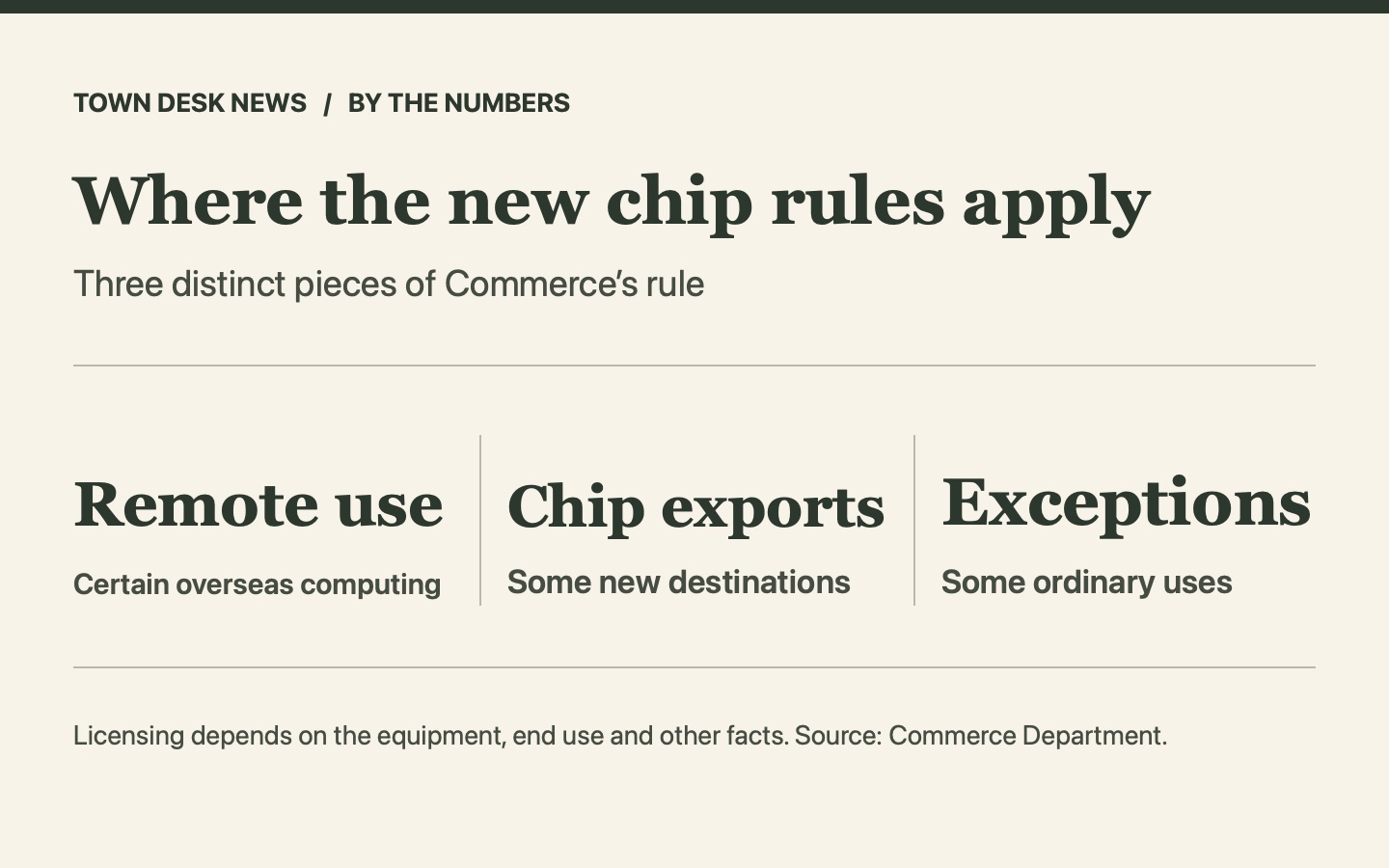
Commerce addresses remote use and physical exports separately; the rule text controls. Town Desk News · Original Town Desk News graphic; based on the linked source.
Five destinations face new licensing requirements
Separate from the remote-use provisions, the rule adds a license requirement for covered advanced semiconductors going to Indonesia, Malaysia, Singapore, Thailand and Brazil. The department says it views those destinations as presenting increased diversion risk. The rule provides a path for covered semiconductors destined for companies headquartered in the United States or ultimately owned by a U.S.-headquartered company, provided the specified reporting conditions are met. The exception is conditional; it does not apply merely because equipment carries an American brand.
The same document changes how some overseas chip factories and advanced packaging companies assess the intended use of certain advanced logic chips. It also removes regulations implementing the earlier AI Diffusion Rule. Commerce says those prior regulations were never enforced and that their formal removal follows a rescission it announced in May 2025. The new approach should not be read as simply turning the earlier rule back on.
What the rule does not tell customers
Reuters reported that the announcement came as President Donald Trump headed to China for meetings with President Xi Jinping, and amid scrutiny of whether overseas data centers could let Chinese customers bypass prior restrictions. The new measure is a U.S. regulatory action, not a trade agreement with China, and it does not itself establish what either government will do next.
Most customers of U.S. cloud services do not need to do anything in response to the announcement. The figures that matter for compliance are the actual processor and server classifications, the countries involved, the end customer’s ownership and what capacity the facility supplies. Companies making purchases or selling access should work from the regulatory text and applicable dates, rather than a summary that says only that Washington is tightening its rules on AI.
Sources & reporting notes
- Agency statement
BIS announcementExplains the intended coverage and policy purpose.
- Regulatory text
Federal Register public-inspection ruleSets out scope, exceptions, and the effective date and comment window.
- Independent reporting
Reuters coverage via EuronextProvides the announcement timing and wider trade context.