BepiColombo reaches Mercury orbit. A shorter burn leaves the next steps under review.
ESA confirmed capture, then reported a software issue. Its Sunday statement said the spacecraft was safe; the earlier science schedule is not a newly confirmed timetable.
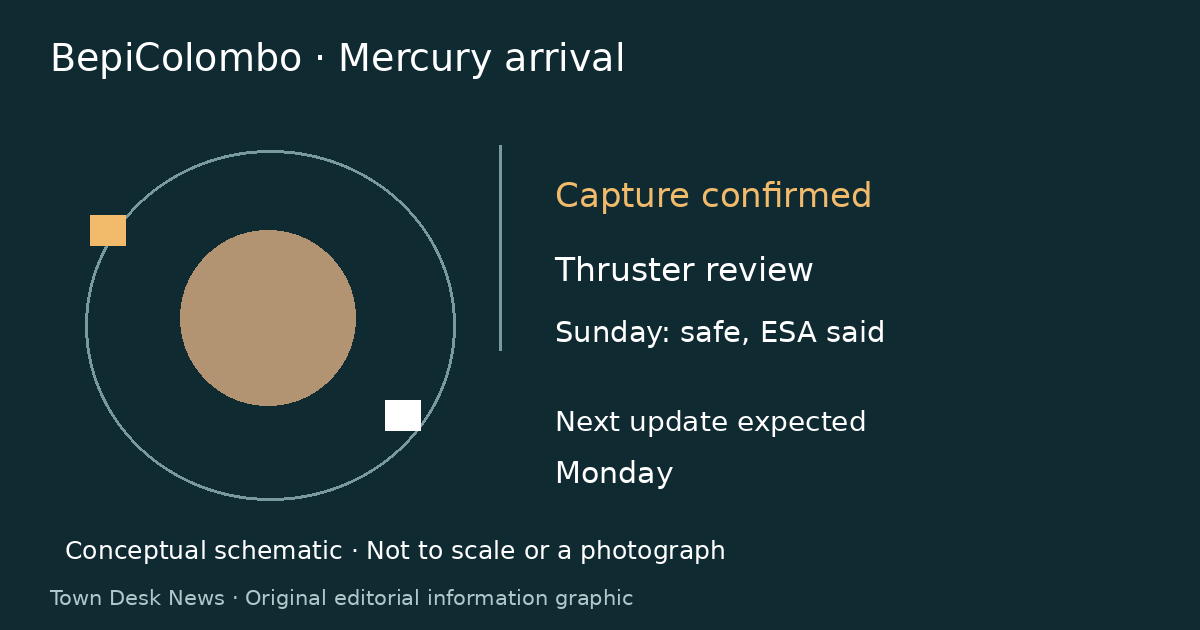
The European-Japanese BepiColombo mission has entered orbit around Mercury, ESA confirmed Saturday, Nov. 21, according to Associated Press reporting. The arrival follows an eight-year journey since its 2018 launch.
On Sunday, ESA said a software issue had cut the arrival thruster burn short, Reuters reported. The agency said the spacecraft was safe and teams were investigating, with another update expected Monday. Those statements describe Sunday’s assessment; a later update is needed to establish the next steps.
Before the issue, ESA’s published sequence planned separation of the two science orbiters for Dec. 9–10 and routine science from April 2027. Those are pre-issue plans, not confirmation that the schedule is unchanged. Achieving capture is also distinct from completing the remaining preparation for science.
ESA’s Mercury Planetary Orbiter and JAXA’s Mio have complementary research roles. JAXA describes Mio’s work as observing Mercury’s magnetic and space environment, alongside the European orbiter’s study of the planet. The mission aims to help explain how Mercury and other rocky planets formed and evolved.
Sources & reporting notes
- Reuters: Sunday spacecraft-status report
Nov. 22: ESA confirmed capture, described the shorter burn and said it expected a Monday update.
- Associated Press: arrival report
AP’s full arrival account, also carried by Spectrum News, attributes orbital confirmation to ESA.
- ESA: arrival sequence published before the issue
The retrieved page’s latest dated entry is Oct. 29; December separation and April science dates are prior plans.
- JAXA: original Japanese mission background
Mio’s research purpose and joint mission context; this page is not a new post-issue status confirmation.