Bell Financial says client data may have been accessed. What should customers look for?
The Melbourne financial group disclosed that a limited number of its systems were accessed. Its filing leaves open what information was involved and who may be affected.

Downtown Melbourne on the Yarra River, in an archive photograph from 2009. Papphase / Wikimedia Commons · CC BY 3.0

Bell Financial Group has told the Australian Securities Exchange that it contained an incident involving unauthorized access to a limited number of information technology systems. It believes some client data was accessed. The group said it was operating as usual and that client assets remained safe. Those are the company's assessments; the filing does not establish the full scope of the incident.
The announcement, dated Friday, Nov. 20, in Australia, did not name the systems involved. It did not say when the access began, how long it lasted, how many customers may be affected or what kinds of information the affected systems held. Reuters reported the disclosure Thursday afternoon in the United States. The date difference reflects the time zones, not a second incident.
Data and assets are different questions
An account can hold money or securities, and the company can separately hold information about its customer. The Bell filing addresses those questions differently. It says client assets remain safe but believes some data was accessed. It does not establish whether particular records were copied or identify the fields in question. That distinction is important for readers who want to know whether they should be checking balances, watching for impersonation attempts or both. The filing alone can't tell a particular customer which advice will ultimately apply to them.
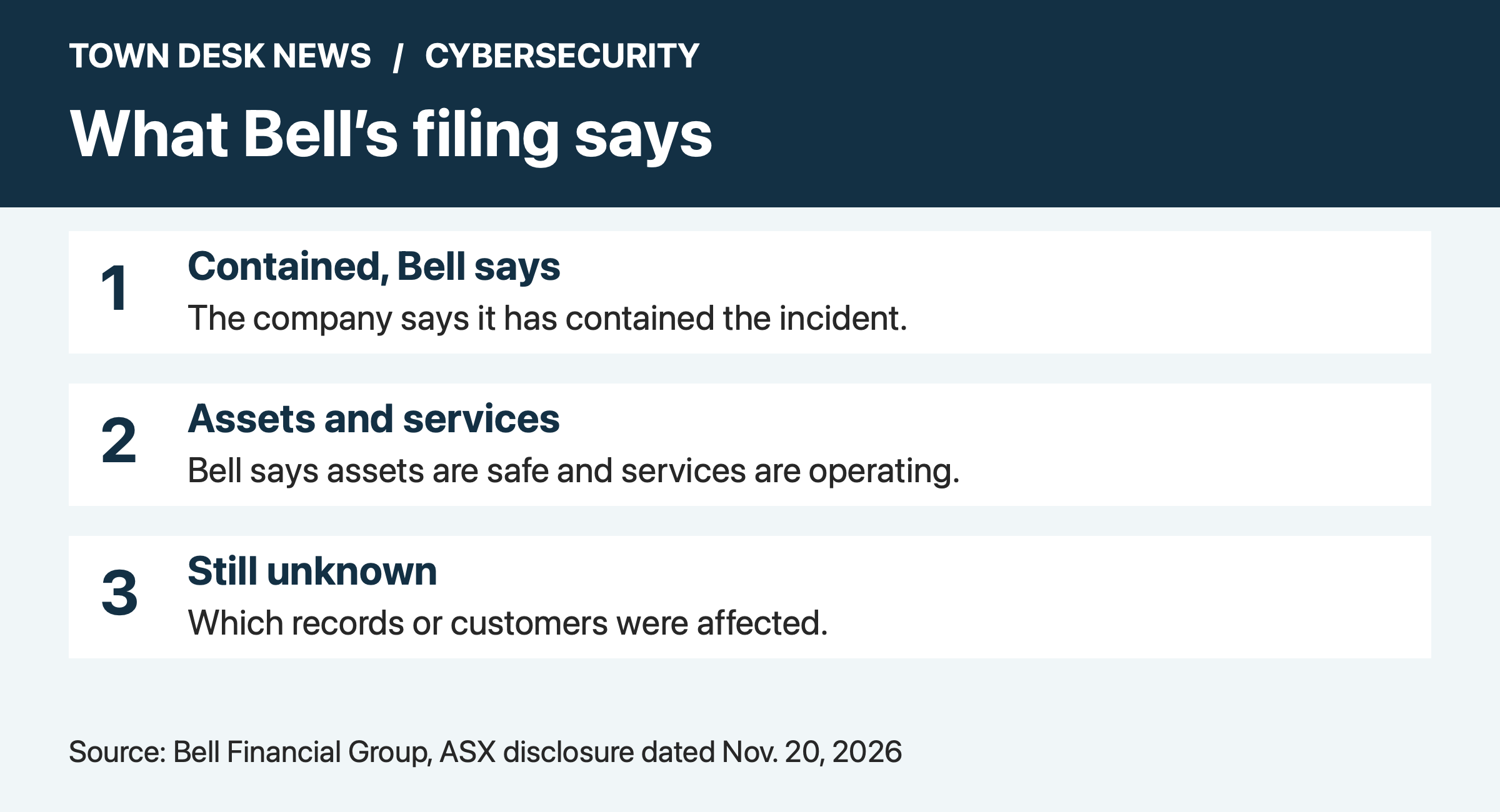
The first filing gives an account of containment, not a list of which customers or records were affected. Town Desk News · Original Town Desk News explanatory graphic
Bell says outside cybersecurity specialists are working with it on the investigation. It said it had notified the Australian Cyber Security Centre and the Australian Federal Police and engaged with the Office of the Australian Information Commissioner. Those contacts describe how the company is responding. They are not separate findings from the agencies about what was taken. Bell says it will contact and support affected clients; it did not say all notices had already gone out.
Bell’s public company profile describes a group with both traditional broking and online investment services, including Bell Potter Securities and Bell Direct. The filing came from the listed parent, not from an individual product, and did not say which businesses used the affected systems. A reader who recognizes one of the brands should not assume that recognition tells them whether their account was involved.
What to look for in any notice
Anyone who receives a message claiming to be from Bell can check through the app or the contact details they already use for their account, rather than replying to the message or following a link in it. That is a precaution against opportunistic impersonation, not evidence of anything someone did with Bell’s data. A genuine notice should make it possible to verify who sent it and say what the company knows about the recipient's specific situation. Nobody should provide a password or one-time sign-in code in response to an unexpected call, text or email.
The Australian Signals Directorate advises people dealing with a breach to check the organization’s official site for updates, watch for unexpected requests and review accounts for unusual activity. Its guidance also recommends changing affected passwords, replacing any reused copies on other services, and turning on multifactor authentication where available. People who think they have already responded to an impersonator can contact their financial institution through a known channel. Those are general precautions, not evidence of misuse or advice to move money.
The most useful follow-up would give clients the categories of information involved and say which groups have been notified. Contact details alone can raise different problems from a record containing identity information. The initial filing doesn't let readers pick between those scenarios. It also doesn't establish a connection to other financial-sector disclosures. A shared week, similar language or overlap in industry is not evidence of a common cause.
Developing story: Town Desk News last checked the company filing and subsequent public reporting on Thursday evening Eastern time, Friday afternoon in Melbourne. We have not independently confirmed which records were accessed, whether anybody copied them, or whether affected clients have received notices. We’ll update this article when there is materially new information.
Sources & reporting notes
- Primary source
ASX: Bell Financial Group’s board-authorized disclosureWhat Bell says it found, and its account of containment and notice plans.
- Company information
Bell Financial Group company profileParent and service names; this does not establish which businesses were affected.
- Independent reporting
Reuters: Bell Financial says some client data likely accessedSeparately reported the disclosure; the data assessment still comes from Bell.
- Local reporting
Financial Standard: Australian trade coverageAustralian coverage of the initial stock exchange announcement.
- Official guidance
Australian Signals Directorate: Recover from a data breachPractical steps for verifying notices and protecting accounts after a breach.