Trump, Xi and Putin have a declaration. What’s actually in it?
China and Russia released a four-point declaration after the Shenzhen talks. It calls for dialogue without setting new arms limits.

Shenzhen at sunset, seen from the Ping An Finance Centre in 2019. This file photo does not depict the APEC summit. Mx. Granger / Wikimedia Commons · CC0 1.0 · Edited

Updated : Adds the full APEC forum’s separate conclusions on digital trade and AI.
Trump, Xi and Putin left their meeting in Shenzhen without speaking to reporters. Then a four-point declaration appeared. China’s Foreign Ministry published it Thursday evening local time, and the Russian text published by Interfax sets out the same commitments. The Associated Press reported that the United States had not released the document separately at the time of its coverage.
The text says the three countries will talk about reducing nuclear risks and preventing the spread of nuclear weapons. It gives no date for those talks and sets no limits on arsenals. The other points call for reforming the United Nations, expanding production and supply of refined petroleum products, and respecting the immunity of state officials in proceedings involving bodies such as the International Criminal Court. The text names neither Ukraine nor Iran and announces no ceasefire in either war.
Donald Trump used his opening remarks at Thursday’s three-way meeting in Shenzhen to call for the United States, China and Russia to discuss reducing nuclear weapons and the risk of their use, according to South Korea’s Yonhap news agency. Chinese state news agency Xinhua reported that Xi Jinping called the first gathering of this kind a milestone. Opening remarks tell readers what the leaders wanted to put on the table. They do not establish that the three agreed to arms talks, let alone to new limits.
Separately, China’s Foreign Ministry said Xi and Trump agreed during their earlier one-on-one meeting to draw up an action plan for managing U.S.–China relations. The ministry also said Xi called for closer coordination on AI safety and for AI to remain under human control. That was Beijing’s account of a two-country meeting, not an announcement of a three-country agreement on AI or weapons. The three-way declaration was released separately after the meeting.
Donald Trump met separately with Russian President Vladimir Putin and Chinese President Xi Jinping in Shenzhen on Thursday, Nov. 19, local time. Associated Press reported the Trump–Putin meeting, and Chinese state news agency Xinhua reported the Trump–Xi session. Neither meeting was the planned three-way discussion.
In Russian-language reporting, Interfax quoted Kremlin aide Yuri Ushakov saying Trump and Putin discussed Ukraine and bilateral ties, and described the bilateral session as preparation for the three-way talks. That is Moscow’s account of the conversation, not evidence of a deal.
The other Shenzhen document
APEC’s leaders issued their own document, the Shenzhen Outlook. It is separate from the four-point declaration released after the meeting of Trump, Xi and Putin. The forum’s text welcomes a 2027–30 framework for digital trade and calls for work on paperless trade, cross-border e-commerce and digital customs procedures.
The Outlook also points to APEC’s 2026–30 AI initiative and calls for cooperation on digital security and privacy. Those are areas for members to work on, not new rules for every member. If you ship goods across borders, the document does not say your next shipment will use a different form or face a different tariff. Watch for a notice from the customs agency that actually handles your goods.
Why an APEC statement is not a tariff change
APEC itself brings together 21 economies. Its own description says the forum works through consensus and does not make binding decisions. That lets economies with different political or regulatory systems cooperate in areas where they can agree. It also places a limit on the effect of a leaders’ statement: it is not, on its own, a customs notice changing what an importer must pay at the border.
For example, participants can agree on a goal of making it easier to move goods across borders. Businesses still need to know whether agencies will accept different forms, whether a procedure changes at the port they actually use, and when the change begins. Those concrete details require work after a general statement. An agreement on the direction of travel is not evidence that every member will do the same thing on the same timetable.
The less dramatic part businesses should watch
APEC’s senior officials identified trade, connectivity and artificial intelligence as priorities before leaders arrived. APEC also describes working groups involving officials and experts who cooperate during the year. That work is easier to overlook than a leaders’ meeting, but it can provide the paper trail for changes in economic practice. Watch for a program, a timeline or a named body doing follow-up work. A declaration without those details still says something about political intent; it says less about when businesses will encounter a new procedure.
Reuters reported that Thursday’s talks could include subjects beyond APEC’s economic work. That possibility is a reason to pay attention to government readouts, not a reason to assume that the leaders are prepared to settle those questions. A readout may emphasize the subjects one government wanted to raise. If the governments describe the same discussion differently, their separate wording matters.
How to recognize a real outcome
The Shenzhen meetings produced documents with different authors and scopes. The Outlook speaks for the APEC forum. Beijing’s account of its bilateral meeting describes China’s position. The four-point declaration is from three participants; it does not speak for the other APEC economies.
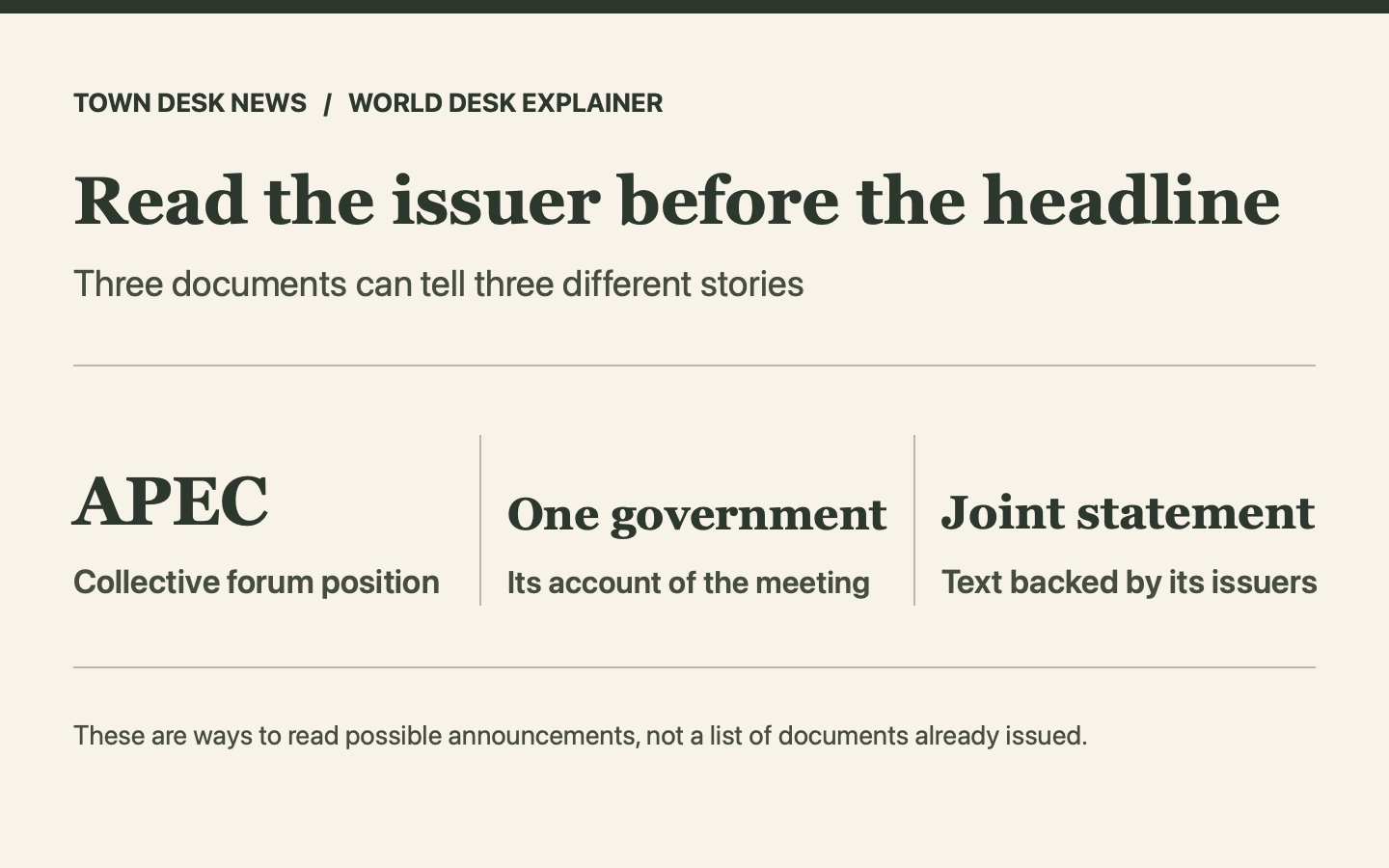
How to distinguish possible APEC and sidelines readouts. Town Desk News · Original Town Desk News graphic; based on reporting and linked source.
Then look for the verbs and dates. A pledge to continue talks, an announced agreement with a text, and an implementing order with an effective date are different kinds of news. The fact that leaders took a photo together won’t tell people ordering components or planning shipments what they will pay. A specific rule, with its scope and effective date, will.
Sources & reporting notes
Confirmation of the three-way session: The Guardian · Anadolu.
For the Nov. 19 update: Associated Press · Xinhua (Chinese state news agency) · Interfax (Russian-language reporting).
- Primary
APEC: Why Shenzhen Leaders’ Week mattersOfficial dates and the forum’s economic agenda.
- Primary
APEC: How the forum worksConsensus, nonbinding decisions and work among 21 member economies.
- Primary
APEC: Senior officials’ Nov. 16 agendaWork ahead of leaders’ meeting on trade, connectivity and AI.
- Reporting
Reuters: Xi, Putin and Trump in ShenzhenNov. 18 reporting on opening remarks, Trump’s arrival, and expected Thursday meeting.
- Primary
Chinese Foreign Ministry: Shenzhen leaders’ meetingHost announcement on meeting schedule and chair.
- Independent reporting
Reuters: Kremlin account of expected Trump–Putin meetingAttributes the expected Nov. 19 sidelines meeting and limited format to Russian officials.