AP called Alaska’s Senate race. Here’s what the state still has to finish
Mary Peltola is the Associated Press’s projected winner over Sen. Dan Sullivan. The official count, any applicable ranking rounds, and certification are separate steps.

File photo: Alaska State Capitol in Juneau, Aug. 31, 2010; not an election count location report. Jay Galvin · CC BY 2.0; resized. · Edited

The Associated Press projected Democrat Mary Peltola would defeat Republican Sen. Dan Sullivan in Alaska, where officials were still finishing the count from the Nov. 3 election. If you saw a winner in the news on Tuesday night but no final certification on the state’s website, both can be true. The AP said Peltola had crossed 50 percent of first-choice votes in the unofficial tally it used for its projection. The state’s Nov. 17 unofficial report listed Peltola at 144,302 votes (50.12 percent) and Sullivan at 131,844 (45.80 percent), out of 287,896 votes in the Senate contest. Those figures were not certification, and the report did not show Senate ranked-choice transfers. Alaska is carrying out the process that turns the count into the official result.
The projection matters outside Alaska because the race sends someone to the U.S. Senate, not the state legislature. Sullivan, a former Alaska attorney general, was first elected to the Senate in 2014. Peltola served in the U.S. House after winning a special election in 2022. Alaska Public Media reported that she had centered this Senate campaign in part on salmon and the consequences of industrial fishing, issues that carried through from her earlier run for Congress.
Why the AP made the call
AP explained its decision in a separate analysis of the race. The outlet said its examination of the reported vote and data released by election officials showed that Peltola would still win even in the unlikely event that she slipped below the majority threshold and the contest went to ranked-choice rounds. That finding is AP’s projection. It is not a state release of those rounds or a promise that first-choice totals will remain unchanged.
What ranked-choice counting would do
For an Alaska race, the distinction between a majority and a lead is important. Voters in the general election can rank candidates. The state first counts the top available choice on each ballot. If a candidate starts with a majority, there is no need to transfer votes among candidates in that contest. If nobody reaches the threshold, an elimination round removes the lowest candidate and transfers ballots to the next eligible choice on each one. A first-round lead by itself is not the same thing as a majority.
Not every ballot necessarily has a next available choice. A voter might have ranked only one candidate, for instance. If that candidate is eliminated and there is no remaining rank to count, that ballot no longer contributes to later rounds. That is why the state’s round-by-round report is more useful than a widely shared screenshot of a single number. It shows both who remained and how the totals changed as votes moved.
The Division of Elections identified Nov. 18 as the date for ranked-choice results to become available after officials finished reviewing and counting eligible ballots. That is a timetable for the reporting process, not a forecast that this particular Senate race will need extra rounds. Voters looking at the results page should check which contest they have opened and whether the report is a first-choice snapshot or a round-by-round result.
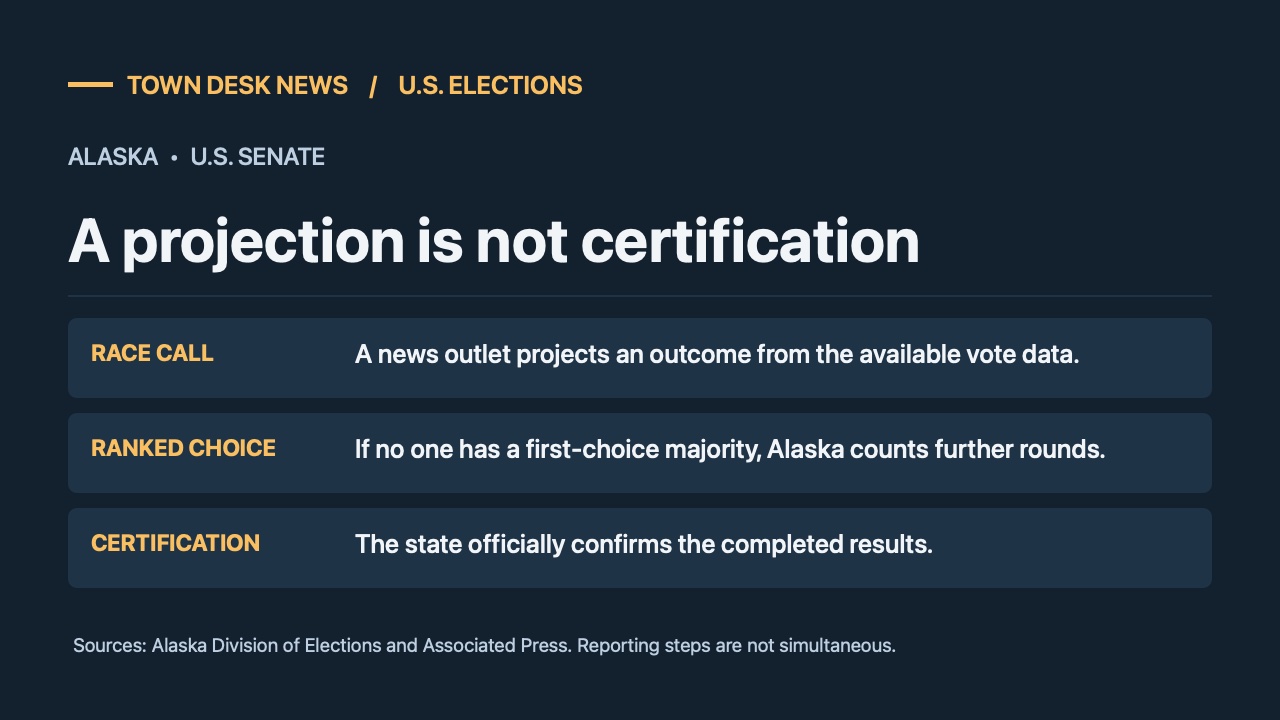
The steps serve different purposes. The Associated Press projects the Senate outcome; Alaska election officials report and certify results. Town Desk News · Original Town Desk News explanatory graphic based on public facts; no third-party imagery.
First-choice totals also answer a different question from the number of precincts reporting. A report can include results from every precinct while some eligible absentee or other ballots are still being checked and added. The state posts the counting progress separately from its certification status, so it is worth reading the report heading rather than drawing a conclusion from a map full of shaded precincts.
When the result becomes official
Certification is another step. Alaska Public Media reported that the state was targeting Nov. 25 for final certification. That date should not be confused with when the Associated Press made its decision, or with the expected day for publishing ranked-choice information. Until official results are certified, look for the timestamp and status on the state’s own reports, especially when comparing them with numbers that appeared before all outstanding ballots had been processed.
That leaves two useful sources for anyone following the race today. The AP’s explanation tells you why its analysts believed the outcome was no longer in doubt. The Alaska Division of Elections tells you what the state has counted and whether it has formally closed out the result. The headline news is the projection that Peltola will unseat Sullivan. The paperwork voters can use to check the finished outcome comes from the state.
Sources & reporting notes
- Primary
Alaska Division of Elections: 2026 resultsState results, information about rankings and estimated release schedule.
- Reporting
Associated Press: why it called the Senate race for PeltolaAP’s reasoning under first-choice and ranked-choice scenarios.
- Reporting
Alaska Public Media: Alaska Senate raceCandidate and campaign context; state’s reported certification target.