Côte d’Ivoire, Benin and Togo will study buying gas together
A protocol signed in Abidjan sets up joint work on demand forecasts and possible liquefied natural gas purchases. It does not set a delivery date.
Agreement signed · Abidjan, Côte d’Ivoire
Three governments signed an agreement to study ways to buy and share gas. It is not a supply contract. Town Desk News · Original Town Desk News graphic
Côte d’Ivoire, Benin and Togo signed a gas cooperation protocol in Abidjan on Nov. 19, setting up work on whether the countries could buy liquefied natural gas together. A signing at an energy trade show can make a plan sound further along than it is. This one begins with a more basic question: how much gas does each country expect to need, and could they meet some of that demand jointly?
The agreement was signed during the SIREXE extractive industries and energy exhibition in Port-Bouët, according to Côte d’Ivoire’s government. Agence Ivoirienne de Presse, the Ivorian state news agency, reported that the protocol calls for a working group from all three countries. The plan is for the group to compare demand forecasts, exchange technical information, and examine joint purchases and ways to move gas between the countries.
What the working group will look at
A shared forecast would help the countries see whether their needs line up. If they need fuel at different times, buying together may not be as straightforward as combining their estimates. The study can look at that alongside how the countries could divide costs, receive gas and send it to users. Those are questions for the working group, not terms that officials disclosed at the signing.
Liquefied natural gas, or LNG, is natural gas cooled into liquid form so it can be shipped. A ship’s arrival alone would not deliver fuel to a power plant. The gas needs to be received and stored, converted back into a gas, and moved to where it will be used. The reporting on the protocol describes possible shared infrastructure as something to examine. It does not establish a terminal location, a pipeline route or a construction award.
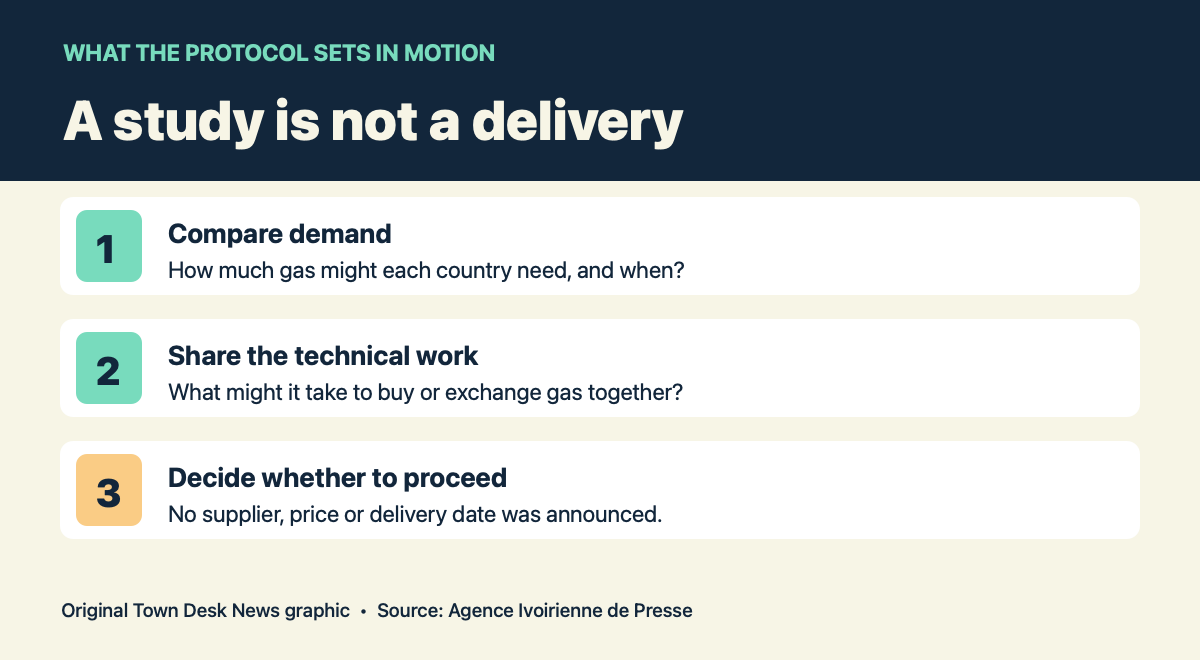
The working group will study possible purchases. A later procurement or supply agreement would be a separate step. Town Desk News · Original Town Desk News explanatory graphic
That distinction also matters for a proposal to exchange gas across borders. A common supply purchase and a system for sharing gas between countries are different undertakings. A buyer cares about when a seller can deliver and under what terms. A utility or gas distributor also needs a route into its own network and enough capacity to take delivery when it needs the fuel. The group is expected to look at both procurement and exchanges.
Why a second way to get gas matters
Benin and Togo already have a regional connection. The West African Gas Pipeline Company says its system links Nigeria, Benin, Togo and Ghana, with delivery points at Cotonou and Lomé. Côte d’Ivoire is not on the operator’s current route. The Abidjan protocol did not announce that the existing line would be extended. It puts other ways of buying and sharing gas on the table.
In Togo, the connection between fuel supply and electricity has been visible. In September, the energy ministry published the power utility’s warning that maintenance on the regional pipeline would interrupt gas supply to thermal plants. The Togolese newspaper La Nouvelle République reported that work in October also disrupted supply to the plants. The point of another supply route would be to give utilities more options when one is interrupted. The new protocol does not establish that this has happened.
The three governments have been discussing this for longer than the trade show. Togo’s energy ministry says they examined LNG imports and possible shared facilities at a regional summit in Abidjan in December 2025. The ministry presented the idea as one way to diversify supplies. This month’s protocol gives the governments a group to work through the details. The next step is still analysis and coordination.
What would turn a study into a deal?
The clearest signs of progress would be a published estimate of combined demand, a procurement notice that identifies the buyer and terms, or an infrastructure plan with a site and timetable. A timetable for studies would not be the same as a timetable for construction or deliveries. La Nouvelle République reported that volumes, prices and the first delivery date still need to be determined.
For households and businesses, that puts a limit on what can be read into the signing. A protocol does not tell an electricity customer whether the next bill or the reliability of service will change. For now, the agreement is a commitment to test ways to supply three markets together. The evidence that it has moved beyond that will be a decision about who buys the fuel, how it gets delivered and when.
Sources & reporting notes
- Government
Côte d’Ivoire government signing noticeSigning date and venue, and goals of the gas cooperation protocol.
- Ivorian state news agency
AIP report on the three-country protocolWorking group, forecasts, information-sharing, joint LNG procurement and possible shared infrastructure.
- Local reporting
La Nouvelle République’s reporting from TogoTogo’s supply context and terms still to be set.
- Government background
Togo energy ministry’s 2025 Abidjan summit recordThe three countries’ prior discussions on supply and shared facilities, not a construction order.
- Government background
Togo energy ministry pipeline maintenance noticePrevious gas supply interruption notice for thermal power plants.
- Pipeline operator
West African Gas Pipeline operationsCountries and delivery points served by the existing regional system.